

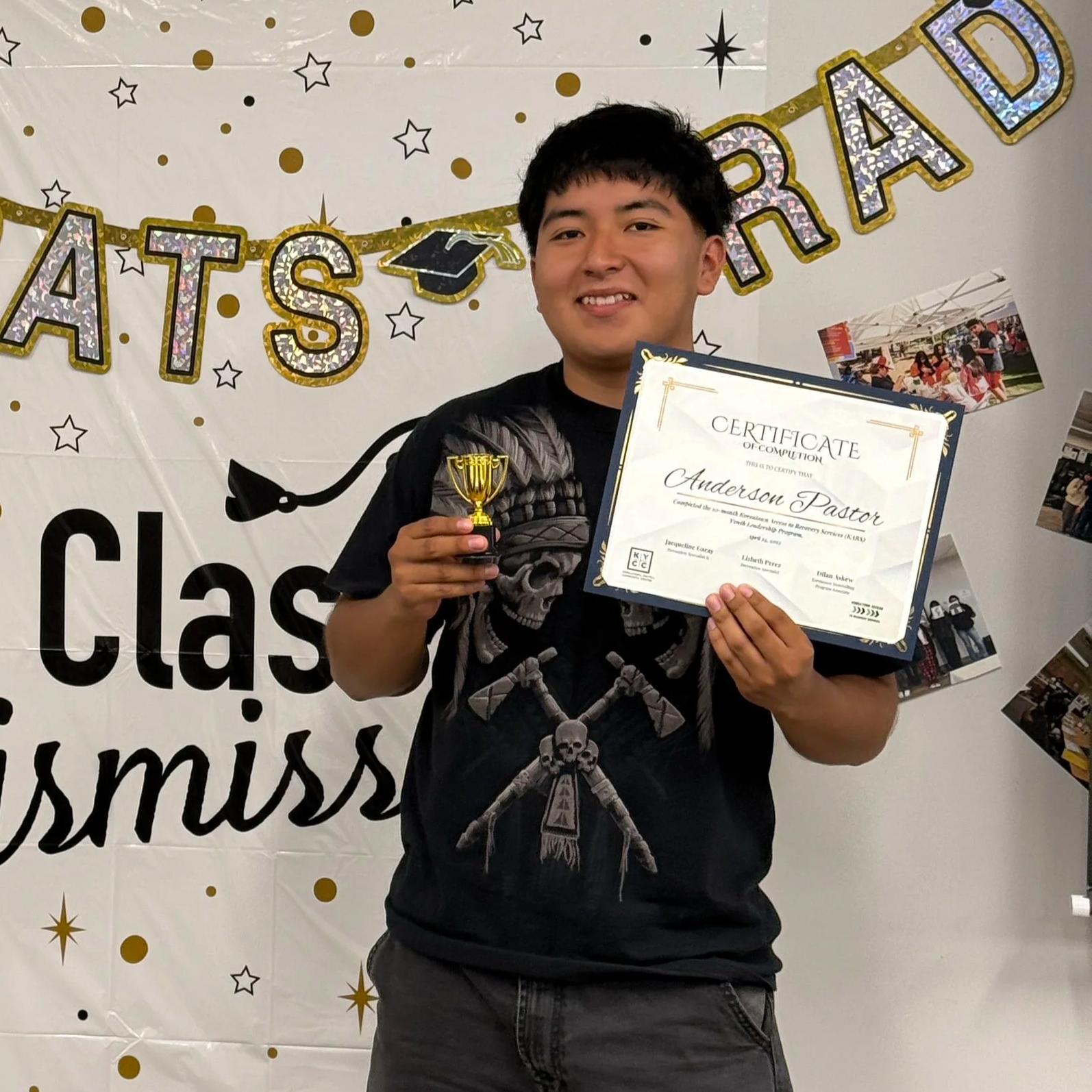
Anderson Pastor
Anderson is a senior at Roybal Learning Center. Originally from Guatemala, he joined the KARS Youth Empowering Council to learn more about community issues and storytelling. Anderson plays soccer and volleyball, mentors younger students through Para Los Niños, and volunteers at his local library. He hopes to study business and finance or possibly psychology at USC.
The Road I Walked
Interview by Kate Jung
Please start with your name, age, and where you go to school.
My name is Anderson Pastor. I'm 17, and I go to Roybal Learning Center.
Where is your hometown?
[I’m from] Guatemala. I was there during my childhood, so I consider it my hometown.
When did you come [to the United States] from Guatemala?
[I came here] three or four years ago. I’ve stayed ever since.
Do you have any plans to go back to Guatemala?
I usually go every December to visit my mom and my other family members. I stay there for about a month [each time].
Do you work in or live in Koreatown?
I did an internship [in Koreatown]. I was doing various [tasks]. I was basically working on scanning papers, organizing boxes of [documents], and then giving them to another person, who would check them.
What are your thoughts on Koreatown?
Honestly, I don't live that close to Koreatown; I live about 20 minutes away, so I don't know much about it.
What are the biggest differences between your hometown and Koreatown?
Society in general and the environment [are different]. You see more mountains and fewer houses [in Guatemala]. It's much freer outside. Since there are fewer homes, I mostly know everyone in the little town where I live whenever I go outside.
What's the biggest culture shock you have experienced?
In Guatemala, you would eat small foods, like just rice and something called a tortilla. That is all sometimes. That would basically be your meal. Here, you have various choices, and there are many types of restaurants that you can go to.
Why did you decide to join KARS?
I had a friend who was involved with KYCC, and he took me to a workshop one time. He told me that they’d be open to taking on new students soon to work on different things. [I thought] it’d be a great extracurricular for my high school requirements, so that's how I got involved.
Do you have any experience with opioids or stimulants? What do you know about them?
No, I don’t. I just know that [opioids and stimulants] can be addictive. I have a little experience seeing it because recently my uncle just got out of addiction. I saw him go through it and get out of it.
Is there anything you learned from your uncle having previously used opioids or stimulants? Are there any effects you’re aware of?
He would usually see things differently; he would relate things much differently than others. For example, if I said something, he would take things more personally and get mad easily when he was abusing opioids. After some time of leaving it, he came back and explained to us that it was because he was abusing [opioids] and how he was now seeing things as they actually are.
Do you know any peers who are or were using stimulants or opioids?
I did have a friend who used drugs, and he actually died. It was two years ago that he died. He was using drugs and was also getting them from people — he got in with dangerous people. He had to pay them back but was avoiding them, and one night, they found him and stabbed him. Unfortunately, he died. That's my only experience with a friend who has done drugs.
Do you have any other extracurriculars besides KARS?
I go to the library sometimes and help with some programs there. I also mentor for Para Los Niños. I worked there for a couple of months. We mentor one-on-one. It’s a small [organization], I would say.
Do you mentor them for school?
If you know any family members or younger kids who need help, you can take a video of yourself teaching them at a certain time and send it to them. From there, you can put in how many hours you worked each day, send that to them with the videos, and they'll pay you.
Do you have any hobbies?
I play volleyball and soccer in my free time. I mostly play soccer after school.
Are you participating in the school team?
For soccer, yes. I am soon for volleyball as well.
What is your plan for these sports?
Last time, we lost the soccer final. We didn't even get a win for volleyball because the team just didn’t communicate. Everyone would get mad, and there was no teamwork. I guess we'll have to work on that.
When you were first playing, did you know that you would go this far with these sports?
I've been playing soccer since I was little, maybe since I was 6 or 7 years old. It's been a big part of my life, and now volleyball is too. I just started playing two years ago because of a friend; he told me that it was fun and a great thing to do after school. After soccer season ends, there's no practice, so there's nothing I would be doing after school. [My friend] told me to join, and I said I would. Ever since then, I have liked the sport. It's pretty fun to play.
Do you have plans to keep on playing these sports when you go to college?
It depends [on whether] I get any offers, which most likely will not happen. If it does, I will play, but I most likely plan to end it after high school. I will still play on the weekends or in my free time just because I love those sports.
You mentioned not liking being home and preferring to be outside a lot. What is your daily schedule like?
I had to change my daily schedule because school started. Before school, I was doing an internship, as I said. I would wake up at 5 a.m., start work at 7 a.m., get out of work at 1 p.m., and then go to the gym. From the gym, I’d end around 3:30 p.m., and soccer practice would [start] at 4 p.m. Now, I go directly from the gym to the soccer field close to my school. Soccer practice ends around 6-7 p.m., and from there, I'll go home, make something to eat, take a shower, and repeat the cycle.
What are the differences in your schedule between the school year and during summer break?
For now, I have to organize myself well because I have to decide whether to go to soccer practice after school or to the gym. If I go to the gym, then I cannot go to soccer practice, and if I go to soccer practice, I cannot go to the gym.
Do you have any favorite foods or drinks?
There is a dessert I like; it’s like a little cake. It’s kind of [moist] on the inside, but it's so good. I don’t really know how to explain it. I haven't found it here [in Los Angeles]. It’s similar to tres leches (three milks) cake, but it's a bit different.
Now that you have joined KARS and you're more aware of these opioids or stimulants, do you see things differently?
Definitely! As I mentioned, I have an uncle who recently went through opioid addiction, and I didn't understand what he was going through. I didn't see why he was doing what he was doing or the reason behind it, but now I kind of understand the difficulties he was going through. I'm getting to know how he felt and what he was going through.
What are your plans for the future?
I plan to study business and finance, but I also [joined] KARS because you never know when you might [make career changes]. My second option would be psychology, and right now, I'm taking AP Psychology, so it could help me in the future if I plan to change my career.
Did you have any set goals when you were younger?
When I was young, I wanted to join the military, but my parents always opposed it. I changed my goals, and now I want to go to college and study business and finance at USC.
Why didn't your parents like [the idea of you enlisting] in the military?
I guess because of my mom. She has a background where her brother was part of the military, and he was killed at a young age. She always told me that as an example of why I should not join.
So there's no chance that you'll ever think about joining the military?
Like I said, you never know what might happen in the future. If something changes, I might still join. It would also help me because my parents are immigrants.
Are you a first-generation immigrant?
Yes.
Were you young when you immigrated, and do you still have memories of coming to the U.S.?
Yes, I [first came here] at age 8, but I went back to Guatemala and then came back again at 13. I have U.S. citizenship, so I have a passport. I could have come by plane, but I made the decision to come with [a family member] to help them get into the U.S., so I had to go through Mexico. I experienced what many immigrants go through, like hunger, coldness, and the worry they all feel.
A particular moment I remember was when we got stuck for 15 days and stayed in a place that was like a small cabin, a very little wooden house. There would be like 40 [people], and every bed was close to each other. It was a bed made of wood, and you just had a blanket. That was it. We were there for 15 days because I think they had difficulties passing us through [the border]. It was really, really cold over there, and [especially] at night, you will feel it — the one blanket wouldn't help. When morning came, I had to take a shower to stay clean, and I had to use cold water. It was the same thing every day. I probably ate like once a day [during the entire journey] and maybe once every two days during those 15 days [of waiting]. It was kind of rough, but I guess it builds character.
I think the big difference is that a lot of other people who were born here don’t ever experience that, and I think they overlook the seriousness of immigration.
Crossing into the U.S. [the first time] was easy, and that's why I chose to come [as migrants do] because I actually thought it was going to be easy. But all the walking and every struggle over there is so hard. There are things that you don’t think will happen, and then they happen. If [border patrol agents] find you, they'll send you back, and you will lose all your money. You have to be careful.
I'm glad you all successfully came over. What are the biggest differences between your lifestyle in Guatemala and here?
Society-wise, I would say school. Over there, there is only one bus that can take you to school. If [you miss it], you'll be late for sure because it comes every 30 minutes. I had to be there at a specific time. [I’d have] to be outside my house at 7:30 a.m. just to take the bus. It’s much different in Guatemala because if there's no space, you would just have to [hang on from] outside the bus. I know it sounds weird, but many do it over there, and I even did it myself. The bus wouldn't even leave us in front of the school. It would just leave us about 10 or 15 minutes walking distance [from school], and from there, we’d just walk up a hill to school.