

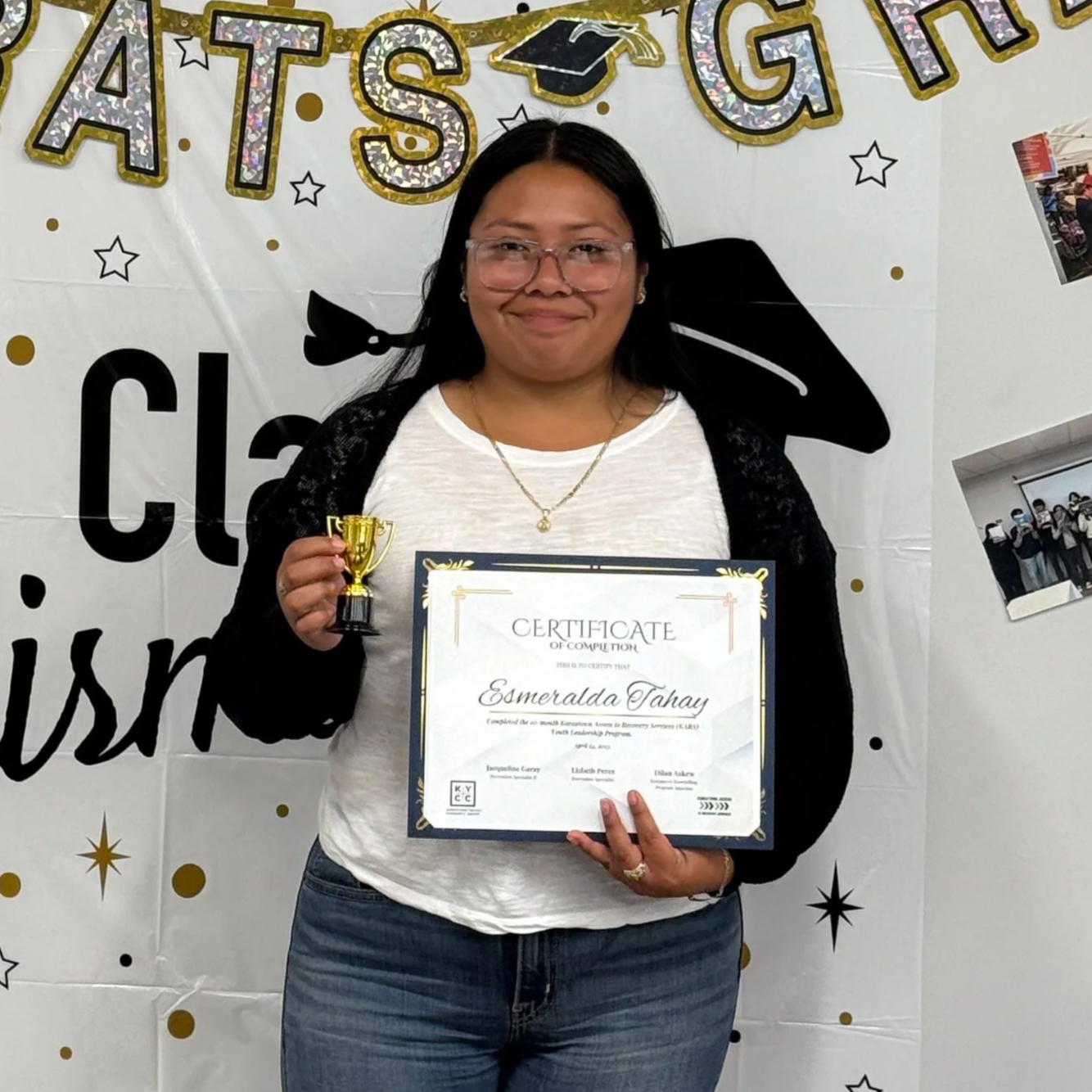
Esmeralda Tajiy
Esmeralda is a senior at Rise Kohyang High School in Koreatown. She joined KARS after hearing about it from a friend and wanting to learn how to use Narcan to help others. Esmeralda has seen firsthand how substance use affects her friends and family, motivating her to raise awareness and share resources in her community. She hopes to become a nurse, possibly in pediatrics or dentistry, where she can combine her love of healthcare with her passion for uplifting and caring for others.
Uplifting Other
Interview by Cora Meija
Please tell us your name, age, and where you go to school.
Hi, my name is Esmeralda Tajiy. I am 17 years old and attend Rise Koyang High School.
Why did you join KARS?
I joined KARS because I wanted to learn about opioids, and I had a friend who joined last year during the 2023-2024 [cohort]. Her name is Ashley, and she told me about the program. I was very interested in learning how to use Narcan. I feel safer now that I know how to use it. If I see someone lying down, I can [ask them if they’re okay]. Or when you see signs [of an overdose], you can help a person out. Plus, I like to do hands-on work, so I think KARS is really cool. I feel like it's very me. It's healthcare-related, and I want to enter the medical field.
Do you have any stories that you can share about opioids or stimulants? Do you know people who use them? Do you have any stories that you've heard?
Some of my friends at school and family members suffer from opioid misuse in their daily lives, which is not good. One of my family members, unfortunately, passed away from an overdose. So if I had known how to use Narcan, maybe I could have saved him or done something for him rather than have him die from an overdose. I feel that's why KARS is such a great help for me.
The materials [KARS] provided us with are very nice because I need to know those resources. I still have some other family members who suffer, so I just want to be there for them. I want to show them the programs that KARS offers so they can speak to someone. My family is Christian, and we're very religious, so some of them might take it offensively if we tell them something. But if they get some one-on-one time, maybe they can open up to whoever they're talking to and tell them why they're doing what they're doing.
How do you think KARS impacts your community and your school?
KARS came to my school. I think it was the student conference; they came to talk about what KARS is and why to join. I wasn't able to be there, but I feel like KARS has a big impact on all of us who are a part of the program. The people I talk to tell me, ‘My family members suffer [from substance misuse] as well.’ So we're all here trying to support a family member or a friend, and I feel like that's a good thing about KARS because they know that it’s not just about thinking people can find help on their own. No, KARS has a lot of resources and programs that they offer to people in need.
We also do [outreach] at church. We go to MacArthur Park once a month and share resources with people. We tell them, “If you suffer from this, you can come and talk to us,” and they'll let us know that they do need help. I feel like that's why KARS has had a big impact on me. I tell my teachers about what we learn in KARS, how we are learning about opioids. They're like, ‘Oh, that's so cool. What is it? Tell me more when you go back to your program.’ I’m always like, “Okay, I got you.” KARS has had a [significant] impact on my family and me.
You mentioned earlier that you wanted to major in something healthcare-related. Would you say that your personal experiences have led you to want to explore something in that field?
Yes, because my grandma passed away from diabetes. She’s from Guatemala, and when we were all there, they didn’t have very good resources. They just gave her so many medications, and some of the medications weren’t even helping her. I said, “Why are you guys giving this to her if it's not going to help her?” Then they said, ‘It will, but you have to be consistent.’ But once she was consistent, she still didn’t see any progress. I thought there was no point in [the doctors] giving her that medication because it's probably just bringing her down more than where she was already.
I decided that I wanted to be a nurse in a pediatric or orthodontic office. That's what caught my attention. I like working with adults and kids, and seeing myself in scrubs was like, Okay, yes! I want to help people through resources. I want to be a person others can communicate with. I want to be someone they can trust. I'm not going to be a nurse or a dentist who just fixes things. No, I want to be someone they can talk to. It would be nice not just to be someone there to do a job; I want to get to know them and [learn about] their daily life as well.
Do you know any peers who are using opioids or stimulants?
Yes, I know a lot of people [using substances]. It breaks my heart because one of them had an overdose recently. He's into alcohol and is a minor — I think he's a sophomore. Well, I have another friend, and she offered him alcohol. When she saw that he had [lost consciousness] and an ambulance came, she reacted to what she had done. I was like, “Well, it's too late now.” Not trying to be mean, right? I was like, “You need help. You know what you're doing is wrong. You're hurting yourself, and you hurt him. If it had gone worse for him, I don't think you would be here right now.”
I feel bad because to this day, that kid hasn't shown up to school. But I talked to my friend about how things could have gone wrong for them both, especially since she was the one who gave him [alcohol]. I was like, “If you ever need someone to talk to, I'm here for you. Don't worry.” And she was like, ‘Yeah, but it's hard to let alcohol go when you're just very stuck in it.’ I get it because I have family members [who also struggle], but it just breaks my heart. We obviously want to do something for them, but if they don't want [to make changes], then we can’t force them to. They have to do their part as well.
I told her that she should stop, but she has other friends [who drink as well]. It's always the friends. You have to know what kind of friends you have. If you don't have the right friends, they can bring you down. If you choose the right friend group, they can encourage you to stop, but others won’t. That's not what a friend group should be like. They should tell you it’s wrong and that you shouldn't do it, but at the same time, not say they won’t be your friend. [People who use substances] obviously need someone to talk to. If you tell them something like that, they might feel bad and not open up to anyone again.
So yeah, I do have a lot of friends [who use substances]. I want to get them into KARS to [show] them how it could affect them, but I know they won’t. Whatever I learned here, I try to tell them so they know. Although I know they might get mad, I just want them to be informed of what it could do later on in their lives. So that's why I feel like KARS is a big thing for me.
I also tell my family members. Thank the Lord, one of my uncles has already changed in just two months. He has been going to church consistently and has stopped drinking and smoking. My dad and I are very happy for him. It's a good thing because on my dad's side, they lost both of their parents, so I feel like that's what brought him down. However, the Lord is picking him up slowly but surely, which is a good thing. I'm so thankful for that because I know that he's going to do well.
With my friends, it’s up to them. I'm going to try to do what I can, but at the same time, I can't force them. Like my cousin always drinks, and I tell her, “Look up to your other sister. I'm telling you, you could do better than her, and then you could show that to your other siblings.” It's hard for me because I'm the oldest. [I’m the first in my family] going to college, and I want my siblings to look up to me. But if I do things wrong, they're going to think it’s not worth it. I want them to see that it is worth it and that they can do better than I can.