

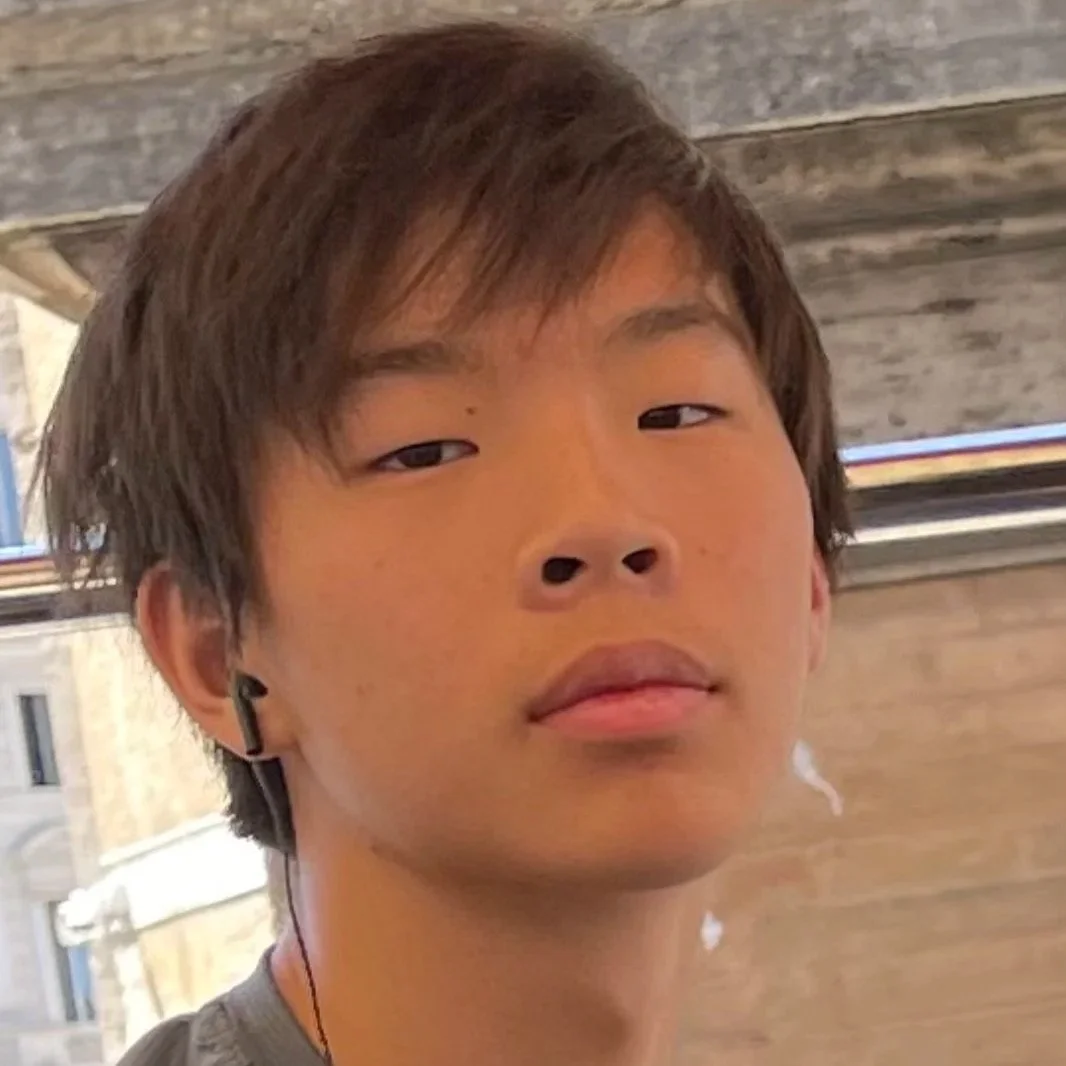
Chase Nam
Chase is a sophomore at Loyola High School in Los Angeles. He has lived in La Cañada for the past two years and previously lived in Koreatown. He is interested in journalism and writing as a means to express his ideas and share information that he believes is important. Although he spent his childhood in Koreatown, he doesn’t know much about it and wants to explore more of its culture and history. He can speak and understand basic Korean, swims for his school and club team, and contributes to his school newspaper. He hopes to study marine biology and ichthyology in the future.
Maintaining Connections to Koreatown
Interview by Nadia Cho
Where is your hometown?
I mostly grew up in Koreatown. I [lived in] a house near Koreatown, by Windsor Square. I’m not sure exactly which neighborhood it fits into. I spent most of elementary and all of middle school there. I moved to La Cañada (Flintridge) around 2020, but I don’t really consider it my hometown because I didn’t spend much of my childhood there. I go to Loyola High School, which is near Pico-Union. I’m still able to do many of the things I used to do in Los Angeles. I go to Koreatown almost every day, so it’s still a huge part of my life.
Why did you move?
My parents mainly wanted to move because they thought La Cañada was a safer, more peaceful neighborhood. They were a little scared during some parts of quarantine when L.A. had looting and riots, so they wanted to move to a safer neighborhood. La Cañada is a little quieter [than Koreatown]. There aren’t as many restaurants or stores; it’s more of a suburb. Koreatown has a lot more options for everything.
Do you prefer La Cañada or Koreatown?
It’s hard to decide because I feel like I still kind of live in L.A. by going to school there. If I went to school in La Cañada, it would be easier to compare the two, but I feel like I’m in both places now. I do appreciate the more peaceful atmosphere in La Cañada, but having to drive a lot farther to get to school is more inconvenient than when I lived in Koreatown.
How long has your family been in the United States?
My grandparents on my dad’s side first came to L.A. sometime around the 1960s or the 1970s. That was when Koreatown wasn’t really formed yet as a Korean community with a bunch of Korean restaurants. My grandparents told me at the time that there were very few Korean restaurants. It wasn’t the Koreatown that you know today.
My dad came to America when he was 8, around 1970. My mom came here much later, maybe in the ’90s or early 2000s. My mom’s family — her sisters and parents — still live in Korea. My dad’s side has been here a lot longer. Almost all of his side is in L.A. now. My dad is a much more fluent English speaker, while my mom still has a pretty thick accent because she hasn’t been here too long.
What are your overall thoughts on Koreatown?
It’s hard to compare it to other places, but it’s nice being in Koreatown. My parents, especially my mom, place great value on maintaining aspects of Korean culture. Even living in L.A., being in Koreatown with all the Korean businesses, restaurants, and so many Korean people around is easier to do than if I were living anywhere else.
I speak a little Korean at home with my mom because it’s more comfortable for her. I also did a Korean dual-language program in elementary school. If I were anywhere else [other than Koreatown], I wouldn’t have those kinds of opportunities. Most schools don’t offer Korean as a language course, except maybe in Korea, where there are so many Koreans that it’s important. If I lived somewhere else, I might not even speak it or only know very little.
What was it like to be in a Korean-immersion program?
It was just a class that, beyond just teaching kids Korean, also taught Korean culture. There was a Korean drumming [class] where we had these huge traditional Korean drums, and we went to perform and learn how [to play] them. We would have a Korean class on top of other classes. Otherwise, it was pretty similar to regular classes, except our class was separated from other classes, even in subjects that weren’t related to Korean.
I grew up around a lot of Korean kids. A few [students] ended up at my high school. I still talk to those people. When I was in elementary school, most or all of my friends were Korean.
What was middle school like for you?
I went to a different middle school called St. Brendan, and there weren’t [many Koreans]. It was a private school, and there weren’t any Korean programs. At that point, my friends were mixed, which continued in high school. I’m not in any kind of program that forces me to be with all Koreans now. There are a variety of [students].
There are advantages to having Korean friends or friends from Vietnam because there’s a little more to connect with, like the [similar] traditions you grew up with and the traditions they mostly grew up with. So when you’re in a public setting, you’re more comfortable not changing. You won’t be scared. If you are with people from a completely different culture, you might be a little nervous about showing signs of your culture because they wouldn’t really fit in. But if you’re with Koreans, it’s easier.
What is your favorite thing to do in Koreatown?
Since there are fewer Koreans in La Cañada, I’ve been eating more delivery food since I moved, especially during quarantine. The food around here, like the local restaurants, just doesn’t give the same experience [as restaurants in Koreatown]. When I’m in Koreatown, there are a lot of good restaurants, even non-Korean restaurants. There’s one near my school called Dino’s Chicken, which is pretty good. But those kinds of restaurants [in Koreatown] just have a different feel that I enjoy. When I’m there, that’s something I like to do. I go to this Korean-Japanese restaurant a lot, and they serve Americanized food. That’s one of my favorites because of the sushi itself. There are a few Korean restaurants that I’ve been going to a lot since I was a baby.
Over time, I’ve grown to like the foods that they have there. If I grew up elsewhere, my taste buds would be different. But that just has to do with going to the same restaurants. Loyola is not too far from Koreatown; I’m not sure exactly which places are considered [part of] Koreatown. But this place called Wako Donkatsu is in Koreatown. Also, in middle school, I would take some friends there, even if they weren’t from the area or didn’t know Korean culture.
What’s your favorite memory of Koreatown?
I remember celebrating my grandpa’s birthday. A lot of my family was there at that time, and I don’t usually see them. My grandpa has a new wife, a Japanese-Korean woman with a whole family of her own, so I have a lot of stepcousins. But I don’t usually see my aunt. I don’t see those who were there very often, so it was a nice experience. It’s usually just my parents and me eating, but there were about 20 people there.
My grandfather and grandmother have an interesting taste. We had Asian delicacies, so they had kebabs there. Besides the usual things, like regular chicken or steak meat, they had cow tongues, cow hearts, and that kind of thing. I tried one. I don’t remember [the organ meat] being especially good or bad. I just didn’t want to keep eating them because the thought of eating that kind of thing is a little unfamiliar to me. I was a little grossed out, but it didn’t taste bad. I honestly can’t remember the name of the restaurant. It’s a Korean-Chinese restaurant in Koreatown.
What’s your family like?
Most of the year, it’s just my parents and me. I don’t see my extended family a lot. There are occasions when I see them. I don’t see them, live with them, or eat with them that often, though. When I do, those kinds of memories stand out. I’m not that close [to my cousins] because I only see them maybe once a year, and most of them are a lot younger than I am. I have a traditional kind of friendship with them. I’m just not that close with them, especially on my grandmother’s side, because they weren’t technically part of my family.
I have a cousin on my mom’s side who I’m a little closer to but don’t see often. My stepcousins on my grandmother’s side live mostly in Koreatown. The cousins on my mom’s side are two older girls who live in Korea. I also have three male cousins living in Marina [in Monterey County], so they’re in California but hours away.
What was it like switching to Loyola from a coed school?
It was a shock on multiple levels! Not only was I at an all-boys school, but it was one with nearly 1,200 students, compared to a much smaller elementary school where we had 30 kids in a class. In elementary school, the same kids were in every class, but it’s like a completely different group for every period at Loyola. That sometimes limits the people you can connect with, because if you see them only [in one class] a day, it’s harder [to get to know them] than if you saw them every hour of the school day. So I prefer a coed school. Also, the drive to Loyola takes around 40 minutes.
Sometimes I wish I had gone to La Cañada High School, a coed school five minutes [from my home]. That would make it a little easier in some ways. There are times I wish I were at another school, but [transferring] isn’t a burning desire I have all the time. It’s just something that pops into my head. Transferring would make things a lot more complicated.
One thing I like about Loyola is the swim team. It’s really competitive. Loyola’s swim team is so good compared to other schools I could have gone to. That’s not why I went to Loyola; I found out after I came. That’s just one thing that makes me want to stay. I swim mostly freestyle sprints, like the 50 or 100 yards.
What are the kids like at Loyola High?
There are still Korean kids and Hispanic kids, but there are a lot more white people than Koreatown schools would normally have. I don’t mind, honestly. I know I talked about the advantages of having more Korean friends than anything else, but it’s not much of an issue, and I wouldn’t be uncomfortable with having that kind of demographic at school.
The friends I sit with are all Korean. I know a few other people who are white or Hispanic. Part of it was that I already knew a few Korean friends from elementary, middle school, or even preschool who went to Loyola. [My friends] knew other Korean kids, and eventually I got to know them, too.
It was more about my previous Koreatown connections at Loyola that resulted in this. A lot of my friends are [from Koreatown]. I think they went to the elementary schools there, especially those with the Korean immersion program. Quite a few of them went to that kind of school in Koreatown, but some kids came from completely different areas.
What would you say is your favorite place in Koreatown?
That’s hard to say. I like restaurants like Wako if I’m with my family, but I prefer a [food court] with many restaurants when I hang out with friends. We usually just eat. Sometimes, we do our homework or just sit around. If I need a doctor’s appointment, a dentist appointment, or a haircut, I still go to places in Koreatown. If I meet my family, it will usually be in Koreatown because my grandparents are there and it’s easier for them.
I don’t know if those connections to Koreatown will stay for my entire time in high school or if they’ll slowly fade away as I get more used to living in La Cañada. It’s not something that bothers me. It’s going to be a gradual change, and if it happens, I don’t think it’ll have a negative effect.