

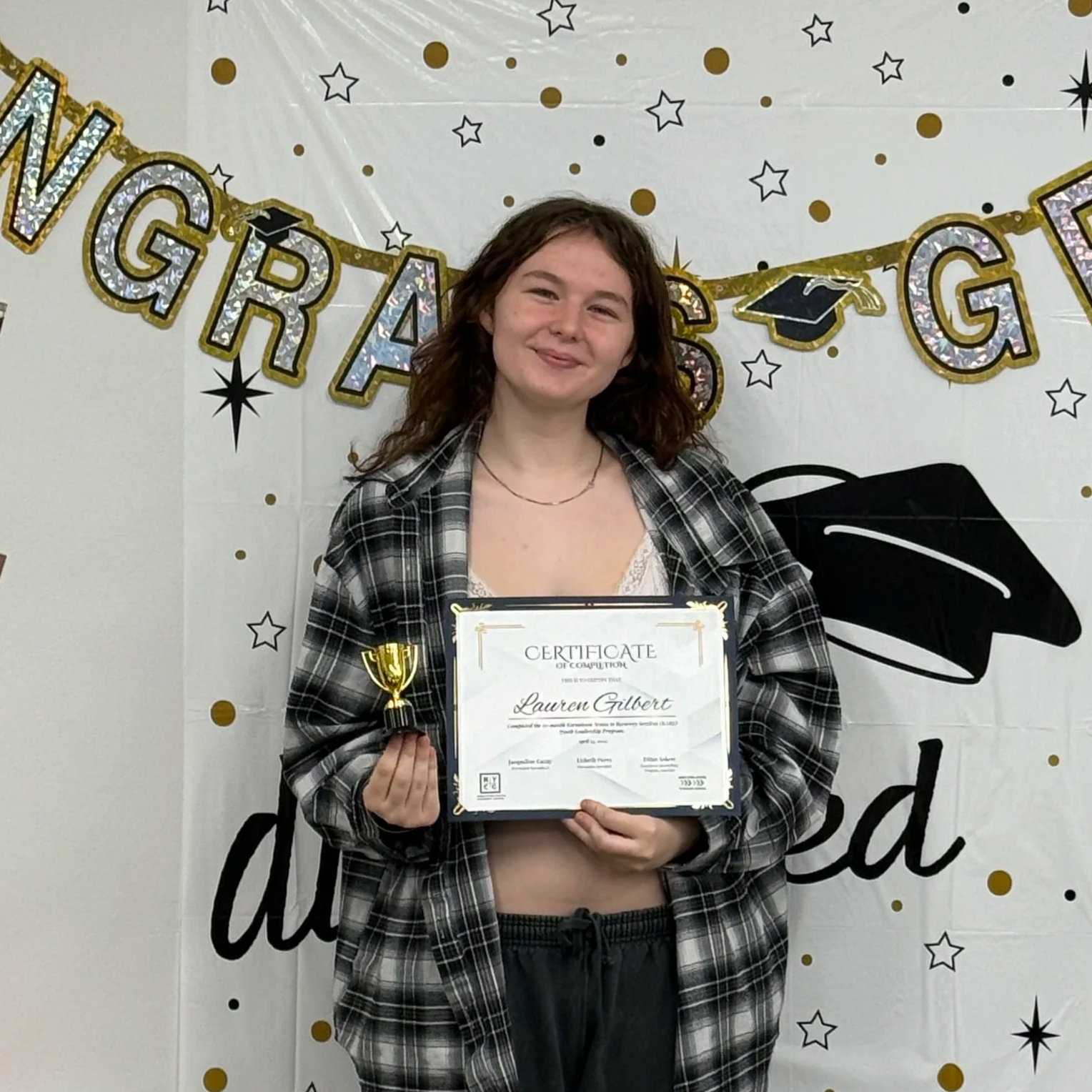
Lauren Gilbert
Lauren is a senior at Hamilton High School who lives near West Adams and Culver City. She has participated in KARS and other programs like Peer Health Advocates and suicide prevention initiatives, where she engages in outreach, education, and advocacy around substance use. Lauren emphasizes that addiction is not a reflection of weakness but often a result of unaddressed circumstances or lack of resources. Her focus is on helping others navigate addiction with support, perspective, and the understanding that recovery is possible.
Helping Others Is My True Calling
Interview by Diana Orellana
Can you start with your name and where you go to school?
My name is Lauren. I go to Hamilton High School.
Do you like it there?
No. It’s pretty mediocre, but some things are really nice about it. I’m taking an AP Psychology class and philosophy, which I think is pretty exciting about our school because not a lot of schools offer that.
Where’s your hometown? Do you live here in Koreatown?
No, I live on the brink of West Adams and Culver City. I grew up in two other places besides California. I lived in Idaho for about five years before living here. I was in North Carolina for nearly seven years before that.
Do you miss living in North Carolina?
Yes, for sure. I love North Carolina. It’s a gorgeous state. All the parks are super green, and there isn’t a big trash issue.
Do you have any significant memories of Koreatown?
I used to go to my substance abuse counseling in Koreatown, at a place we went to one time for a [KARS] field trip. I was hoping to see my counselor and say hi, but he wasn’t there.
Is that your favorite place in Koreatown? Or is there another place that you prefer?
Oh, there’s another place I prefer. It’s called H-Mart, and there’s a really good boba place by it. I love that boba so much!
How did you learn about KARS, and why did you join?
I think my mother said, ‘You should do this.’ I looked into it a little bit more and thought it was actually really cool. I could see myself doing it. It also prepares me for the future career I want. If I work in the mental health field, I need to open up my mind more.
Have you done any other internships that have allowed you to explore this career option?
I volunteered for Peer Health Advocates. I did that for one semester of my junior year. I’ve also done an emergency response camp. I haven’t done much, but I have big plans for the future that I hope will come true. I signed up for a suicide prevention program where I’ll learn about prevention and spread awareness. It’s kind of like KARS. We have an advisory council, and we are working together with people trying to come up with solutions to big world problems.
Before joining KARS, did you have any knowledge about opioids or stimulants?
Yes, I knew a lot of information. I can’t just spit out facts; I’m horrible at that. I knew about Narcan and some of its effects on your body from firsthand experience. My knowledge is pretty much firsthand experience of how opioids and stimulants feel and what they do.
What are the impacts you’ve seen in your community?
We had a kid at my school who overdosed and died. It was really sad, and the school didn’t talk about it much. The topic of opioids and stimulants is very taboo. They’re just like, ‘We get it, you’re trying to hide your feelings and mask it with drugs and stuff.’ But it’s so much more than that! The impact it has is huge because kids are younger and younger and doing drugs. It’s not just smoking weed anymore. Kids are doing fentanyl, which is so dangerous.
Do you know anyone who uses opioids?
No, not anymore. I did know a few kids who were doing heroin and stuff. I was best friends with them, actually, but we’re all clean now.
Do you think that your own experiences helped you help others with their struggles?
Very much. I wasn’t as open-minded to the idea of addiction and what it was really like because I never thought I would face that problem. Then I faced that problem, and it opened my eyes and made me a more well-versed person to talk to. I understand those feelings now and how people feel when they’re struggling with addiction.
What could you do to help spread awareness about drug use at your school?
My well-being center works closely with End Overdose, so I want to have a presentation at the school on how to use Narcan. I would like to see that at my school because I think it could be helpful. As peer health advocates at the well-being center, we can do tabling outside. We have information booths where we can talk about sexual health, opioids and stimulants, or different types of therapies. We [cover] a wide range of mental health topics.
Do you feel like your own experience dealing with opioids has led you to this career path that you want to take?
Yes. I wanted to become a photographer before this. I was very into the arts, and I still think about photography, but helping others — maybe it’s cliché to say this — is my true calling. I believe that this is what I am supposed to do. I am supposed to help others because it’s hard to have your own voice when you’re struggling. You think, How can I advocate for myself? I’m such a horrible person. There are people who are advocating for you, though, and they know you’re not a bad person. They see your struggle and support you no matter what.
Was there someone in your life who helped you while you were struggling?
Yes, her name is Vanessa. She changed my life. She was like a mother to me. She used to work in the well-being center. She ended up leaving a year ago, and it was super hard, but she was there on the day of my accident — when everything went downhill. She held me while I sobbed and made me realize that what I was doing was super unhealthy and not beneficial for anyone.
[Vanessa] also got me my first substance abuse counselor. His name’s Steven. He was really cool. He helped me realize that what I was doing was also a little bit selfish, knowing that I was hurting the people around me, yet continuing to do it due to my own issues or problems that I was going through.
Do you feel like that experience affected your mental health?
Yes. One of the biggest things addicts feel is guilt and shame. [Those emotions] ultimately keep you in your addiction because if you feel guilt, you’re going to want to use since you feel so bad. Once you use [substances], you feel shame, and then to block the shame, you use more. It’s just a never-ending cycle of guilt and shame and desperation and not doing the best you can and the best you know you can do.
For my mental health, it killed me a little bit because I always felt like no matter how hard I tried, I would never get better and never grow or succeed as a person. Looking back on that, it’s completely and totally inaccurate because people change all the time, whether it’s for the best or not. You can either go backward or forward. I was going both ways at times, and I still do because [recovery] is not a linear path. It’s more of a wonky up-and-down path. But you want to keep going forward. That’s ultimately the goal.
You talked about Vanessa leaving the well-being center. Was there anyone else there for you when she left?
There were a few other people in the well-being center — Julianne, Rocky, and Niraj — and they were all there for me. They’ve kept in touch. They officially let me become a [peer health advocate], not a volunteer. I’m going to get paid to do it, which is cool. But I don’t care about the paycheck. I care about the experience. My biggest goal is to help people, but they helped me. Also, my boyfriend helps a lot. He was the one who ultimately helped me get off drugs. It was a tough love moment, and he was like, ‘If you don’t stop, I’m going to leave you. I can’t date you.’ So I was like, Damn, I need to get my shit together quick. This is not fun.
Was there anything else that gave you an extra push?
Quite literally everything. I always say “my accident” because I hate going into depth about it, but I had a pretty bad moment where the school found out I had opioids and stimulants on me at one point. They thought I still had drugs in my system when I was actually going through massive withdrawals that were incredibly bad. I got sent to the ER, they drug tested me, and then they sent me to a psych ward. That whole week changed my life. That day, I went to rehab and the psych ward and then entered foster care. So many things happened within the short span of a day. Everyone found out I was on drugs. It didn’t ruin my life, but it definitely made it a lot harder.
What would you tell people who are stuck and keep it to themselves because they’re too afraid of what others will think of them for using substances?
Find the people you’re closest to and trust the most, and be vulnerable with them. I trusted no one in my family. I barely trust talking to my mom about it now, unless I’m making jokes about my addiction, which she hates. The person I was vulnerable with, the one I didn’t think I could be vulnerable with, was my brother. I was scared, but opening up to him was such a relief.
Once you get it off your chest, like, “Hey, I’m struggling and addicted to these things, and I can’t help myself anymore,” then you can get this closure with yourself that you’re not a horrible person. I guarantee you that the other person will validate you, and if they don’t and disregard your feelings, then you can still get that closure with yourself and look at it from a different perspective. Don’t look at it all the time from an “I’m a horrible person” perspective. It’s hard to escape that, but it’s really beneficial once you see a new perspective. It’ll change your life, either for better or for worse, but usually for the better.
Do you think people who aren’t able to overcome this challenge in their lives lack a safe space or resources, or are they weak-minded in general?
They are never weak-minded. I’ve never thought of someone that way. I do think a lot of people reject resources because they’re not ready to get better, or they don’t feel like it’s their time, or sometimes they just really like drugs. Sometimes they’re not ready to give that up because, again, it just doesn’t feel like their time. But I never think it’s because they’re weak-minded and can’t do it. Anyone can overcome addiction. It’s not impossible.
Some people do meth for 50 years, and then one day their kids come up to them and say they want them to stop. So they do, and then they’re 20 years sober. It’s crazy how you can change your life no matter what is going on. Outside factors do play a big part, but at the end of the day, it’s perspective.
I learned in yoga class that people with high stress levels don’t live as long. People with low stress levels live longer. But people with high stress who manage it better and manage it in a positive light actually live longer than both groups. It really is up to how you view a situation. Am I going to view it as my life’s never going to get better, or am I going to see it as an obstacle I can overcome and grow from?
What do you think about celebrities who always talk about advocating for mental health? People assume a celebrity would have fewer worries than the average person who has to work a nine-to-five.
They can have the same amount of stress [regardless of] their position. Everyone’s stress levels [vary widely]. Just because someone’s a celebrity and another person is working three jobs doesn’t mean they can’t both face the same stress levels. If we see people living nice lives, we think their lives must be perfect, which is all fake. It’s not real. Some people do live a nice life, but it’s not because they’re rich and famous. It’s sometimes just because they’re living a nice life.
For celebrities, I can imagine why things are so stressful — all the pressure to be perfect all the time. You can’t mess up or you’ll be canceled. The cancel culture thing is kind of stupid. I don’t think we should immediately hate a person because of something they might have done — unless they’re groomers.
Do you think it’s fair if someone is canceled for something they did in the past, if it’s not that extreme?
Okay, I’m going to get a little too real. Someone’s going to cancel me for this! I’ve said my fair share of slurs that are not reclaimable for me. Back when I lived in Idaho, because it was so normalized in my neighborhood, I didn’t think anything of it, and my parents didn’t tell me otherwise. Most of the time, I would get tricked into saying stuff because I had no clue what anything was. I’m well aware of how shitty I could have been and was. I’m not neglecting the fact that what I did was wrong. I have grown as a person from it, and people are allowed to grow, become better, and not have their past brought up. When people bring it up, they want to use it as motivation to hate and ruin you. Why are we trying to hate so much? Why are we trying to ruin everyone? They made a few bad mistakes when they were 16, and now they’re 25. Leave them alone.
I agree because, as you can change with your addiction, you can also change your mentality. The brain doesn’t fully develop until you’re 25, so there’s a lot to learn. I want to ask about your time living in Idaho and North Carolina. Did you struggle with substance use when you were living in those states? Do you think California has something to do with your substance use?
Yes and no. Actually, it wasn’t until I lived in California [that I used substances]. I was completely sober in North Carolina because I was in elementary school. That would have been terrifying if I weren’t. I got to middle school and hit my very first vape pen in the eighth grade in a fucking church parking lot — a church I literally went to! I was so scared of it, so terrified of drugs. The 360 is crazy. I was so afraid of drugs that I thought they would kill me if I even tried them once.
Then I got really depressed, and I was talking to my friend, and I was like, “What if I just try this?” She told me to just go for it. She’s not a good friend, but I’m still friends with her. She told me she’d done oxycodone. We were in the ninth grade. It was crazy, but I did it and realized I liked it way more than weed because I had tried an edible once before that. Those were my very first times using drugs.
When I hit ninth grade, I hadn’t used many pills before. I did it every once in a while, and I was good. Then the school year came, and people glamorized the shit out of doing drugs. I started doing pills more frequently, like every single day, every few hours, or every hour, just to feel something. It was so unhealthy, but California kind of influenced it because there is such high drug use here. It’s [incomparable] to other states sometimes. Every state has different drug issues; some are just weed users, while [others are into] meth. California has a lot of fentanyl, though, and that’s what makes it scary.
Why do you think substance use is so normalized, especially for kids
Parents and doctors. I say parents because if you grew up around drugs and alcohol, there is an addiction gene. A lot of people fall into drugs due to their parents, and that’s not putting the blame on the parents or the person, but you’re more likely to get addicted to drugs and alcohol if you have a parent who is. I say doctors as well, because they give out drugs like crazy all the time. If you have back pain, they just give you OxyContin. Like, what are you doing? If you have surgery, they give you fentanyl. That’s not how it should work. There should be a limit on what you’re giving and how you’re giving it. It should not be, “Oh, just because you’re having some pain, let’s throw painkillers at it.” Ibuprofen works fine, but everyone normalizes [opioids] to some extent. To be honest, we all do it, and the community itself normalizes it. Once you start, it’s hard to stop because of the community that you build — drug bonds are one of the worst things to experience.
How can that issue be controlled or fixed?
I’m not sure. There are multiple things we could do. It’s not that hard to stop [prescribing opioids], but it’s a money grab, so doctors are just prescribing it because they know it’s an easy, quick fix. But it’s actually long-term. It costs so much because painkillers and stimulants are expensive. If you don’t have insurance, then those doctors are grabbing at your money like crazy. It’s easier and more efficient for them, but it shouldn’t be. If you actually look into what the person needs and how their body functions, you probably wouldn’t need to prescribe painkillers.
Stimulants, on the other hand, are different because [there are medications] like Ritalin and Adderall, and those are actually needed by people with ADHD. There’s no changing that. It’s mainly the opioid epidemic that’s going around, with doctors unnecessarily prescribing things and people getting access to fentanyl because it’s laced in everything, even weed. Opioids are everywhere.
If cities and counties implemented a ban on all these normalized drugs, do you think that would bring these drug issues to a stop? Would it just make everything go underground, keeping things hidden?
It would definitely be more underground. There would be drug rings literally everywhere. There is also doctor hopping. It’s a term a lot of drug addicts use; they go doctor to doctor, asking for pain pills to get a new prescription without making anyone suspicious. So you’ll just go doctor to doctor to get Xanax or something and be like, “Yeah, I haven’t been prescribed anything. I need it for my anxiety.” Then once that doctor stops prescribing it, they go to another doctor who can — surprise! — give it to them. The thing is, these are smaller clinics, not big clinics.
Oh my God, that would make it so much scarier. Do you think we should normalize pills a little bit?
My parent’s partner told me, ‘We just need to put all the drug addicts in one big hotel or something and let the drug dealers come to them so we can keep an eye on them.’ It was a weird thing to say, but I was like, “You know what? You’re onto something.” They would fill so many buildings, but they’d be a lot safer. We could give out clean needles and safe medication instead of laced drugs. Should the addiction aspect be normalized? No. Should we normalize helping addicts, though? Yes, because they’re in one of the most desperate parts of their lives when they have to use drugs to cope.