

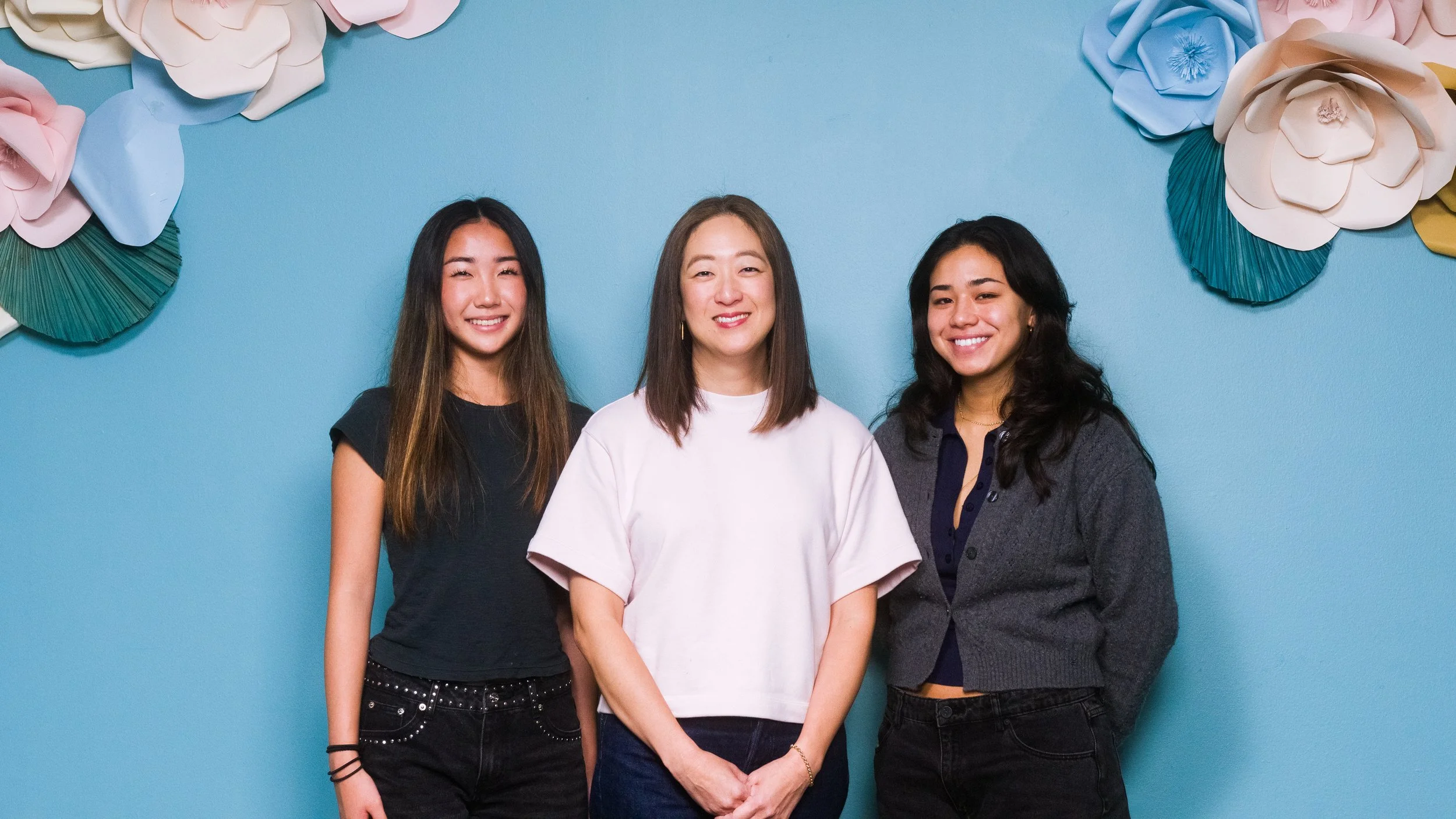
Connie Chung
Connie is a second-generation Korean American city planner and Managing Partner of HR&A Advisors’ Los Angeles office. Born and raised in Pacific Palisades, she found her calling in urban development after earning a graduate degree from MIT. Over 12 years at HR&A, she has led landmark projects in parks and public space — including Boston’s beloved Lawn on D — while championing equitable community engagement and climate resilience. A lifelong Angeleno and mother, Connie is driven by the belief that great public spaces create a true sense of belonging.
People and Relationships Are Critical to Success
Interview by Daisy Yun and Sarah Barnavon
What is your name and age? Where were you born?
My name is Connie Chung. I am 45 years old, and I was born here in Los Angeles.
How do you identify in terms of generation, race, ethnicity, gender, and preferred pronouns?
I use she/her pronouns. I think of myself as a second-generation Korean American. My parents came here in the late 1960s or early 1970s. I was born and raised in L.A., so I think of myself as American.
Where is your hometown, and where did you grow up?
I grew up in Pacific Palisades, and my parents moved into the house where I was born in 1978. So L.A. is my hometown, but I was raised in the Palisades in the 1980s.
Can you tell us about your family? How many family members did you have, and what were your parents’ occupations?
We are a family of four. My parents had a garment business. Well, for many years, they ran a sewing factory and then a washing factory focused mostly on denim. They ran that business my whole childhood, essentially. My brother was born in 1978, so he is my older brother. It’s just the four of us.
What was your childhood like?
Growing up in the Palisades was actually sweet. When my parents first moved to L.A., they lived in the Diamond Bar area with lots of Korean folks, and they actually discovered the Palisades driving one weekend before my brother and I were born. I think they decided to take a shot at this — unknown to them at the time — area that was not as populous with Korean people.
When we grew up in the Palisades, it was actually a very sweet community where everybody knew each other. It was very suburban. I remember growing up, and I do not know if this is how it feels for kids these days, but we would walk barefoot down the street to meet friends, and it was almost unsupervised, but in a very safe and loving way. We knew all our neighbors.
I spent a lot of time riding my bike. I was a rollerblades girl for a little while, but I was always out on my bike exploring. I had friends in the neighborhood, and there were a bunch of construction sites at one point, so we would go check [them out]. They were not gated at the time. We would walk on and figure out where the bathroom was going to be and where we would go up the stairs. I cannot believe that this is what we did, but everyone survived, and it was a lot of fun. I remember being outdoors most of the time, in the neighborhood, meeting friends, and swimming a lot [at the recreation center].
You mentioned your parents worked in the garment industry. Were you involved in their business at all?
My parents started a factory in the 1970s. When they decided to start the factory, my dad had been searching for a lot of different businesses. Several Koreans in L.A. had also begun in the garment business, and so through word of mouth, my dad figured out that this was a good entrepreneurship path for a Korean family.
My mom worked at a factory for a few weeks and learned the ropes a little bit. She was a Korean speaker and a new English speaker, and then when it was time to open their factory, she had that experience under her belt. She also had poached one of the managers from that factory to start it with them. So they started the business, and it really defined their lives while we were growing up. They worked so hard. They worked every day. I think my dad always worked on Saturdays. He usually took Sundays off, but it defined how I thought of our family — what they did and how they were able to achieve things for us.
To the question of “Did you ever participate?” I actually thought I was going to go to college for business and then become a part of the family business and help run it. I remember at one point, my dad said to me, ‘You know, the garment business is not good for young women.’ But later, we talked about how he thought I was more academically inclined. Also, the garment business can be cutthroat, so he did not really want me to experience that kind of hardship or that [business experience]. Of course, in his mind, he probably thought, ‘She should become a lawyer.’
It sounds like you are very close with your family. How do you manage work and family time together?
Managing work-life balance or family-work balance is really challenging. In addition to my family that I grew up with, who are here in L.A., I have a 5-year-old and a husband. So now I have the responsibilities of both sets of families. I find it is really hard. I work really hard so that I can provide for everyone.
At the same time, I want my daughter, Vivian, to understand the value of finding work you are passionate about and then following your path to do it and succeed. So what that means is I still work hard, and I try to explain to her when I am busy or traveling for work. I do travel for work a lot. I explain where I am going, and she is 5, so she does not totally understand what a meeting, a conference, or an interview is. But I try to explain to her that I am going to be with different friends [whom] she might have met, and I tell her what city I am going to, and she will ask me about it later. Sometimes I even try to take her with us — take my whole family on work trips. We went to New Orleans, and now she has seen and experienced a place like that with her own eyes, which is really cool. I do not know if it is balanced, but it is putting it all together more.
Growing up as a native Angeleno, what early experiences or places in Los Angeles shaped your understanding of cities, communities, or public spaces?
I grew up in the 1980s. As I mentioned, I grew up in the Palisades, which is like a world away from Koreatown in some ways. But when I was little, we would come to Koreatown every weekend, sometimes both days of the weekend. I remember, for example, when the Koreatown Plaza mall opened up, we were there constantly. It was just where we went for grocery shopping, other types of shopping, and just to hang out. The fountain, the escalators — all of those are so prominent in my memory of my childhood.
We spent a lot of time just playing in the parks around our area—the rec center, the park, Rustic Canyon, and all the hikes up to Los Leones and all those trailheads. My brother was a Boy Scout and worked on a lot of volunteer projects. He worked on the trails, and I remember spending a lot of time up in the mountains, too. I am not a hiking person, but it was definitely part of how we spent time. We also had very close family in Westminster in Orange County. My favorite uncle lived out there. So there was always the trek — an hour south on the 405 — to see him and to do all the holidays together: Korean New Year traditions and Thanksgiving. That was also kind of a world away from Koreatown and where I grew up.
What inspired you to study city planning and eventually work on parks and public spaces?
Growing up in L.A., I do not think I really had a sense of the city as a city, the way I think of it now as a city planner. I had a sense of different neighborhoods and regions, and they were all kind of different pockets in my head — talking about Orange County and certain parts of L.A. and different neighborhoods.
When I was maybe a middle schooler and then a teenager, my parents wanted us to see the world. I remember when I was 12 or 13, they took my brother and me to Paris and London, and that was the first time I really felt amazed. It was incredible. I remember they would sometimes take us to New York City, which was also a crazy thing to experience in the 1990s.
I got to know cities outside of L.A. before I really thought of L.A. itself as a city. It was just kind of [taking me] out of my comfort zone. I always wanted to move to the East Coast for college, so I went to college in Philadelphia. When I was getting opportunities to study abroad, I decided on Paris because of the memories I had as a kid visiting. I had spent a little bit of time traveling there as a teenager. So I got to study abroad there, and that was really eye-opening for me as a planner.
One, I took a class with a professor who had us meet in a different part of the city every time [we met]. It was kind of an anthropological history of the city and an architectural history of how a city as ancient as Paris had so many layers of communities that had lived there since the [Medieval Times] and even before that. It was the first time that I kind of intellectualized what it meant to study a city. It helped me put L.A. and other cities that I lived in — Philadelphia and New York — into context.
I was studying business because I thought I was going to run the family business. I went to get the degree and figure out how to run the business. Then I realized I was so unhappy in this environment that was very finance-focused and very much focused on “How do we turn $1 into $2 into $4 into $8?” It did not resonate with me personally. So I thought, Well, I really like legal studies. Maybe I will be a lawyer. I actually was a paralegal in New York City after college, helping lawyers put together corporate deals. Part of that ended up being about real estate.
In my role as a paralegal, I would read all the background information on the legal documents that I was helping to prepare and edit. I’d find so much interest in the projects that were the subject of a financing deal or a legal agreement. It sort of harkened me back to that experience studying abroad in Paris, thinking a lot about cities. That made me realize that I had actually taken the LSAT but did not want to become a lawyer. I didn’t think pursuing the family business was for me in the end.
I went back to school for city planning. That was when I went to MIT, and it was an incredible two years of my life when I thought I had found people I related to. It was so nerdy in the most delightful way. It was a lot of fun to work so hard at something for two years, which I had not expected. I had not planned it as a teenager, and I certainly did not even know what city planning was when I was your age.
You mentioned you went to MIT. How do you think being in Boston or the Massachusetts area changed the way you see cities, and how did that lead to your career path?
[I lived] in the Boston area for three years. I lived in Cambridge. I think it was an interesting experience, having lived in New York and previously in Philadelphia and coming from the West Coast. It was an eye-opening experience because I experienced Boston as being so many wonderful things but also highly segregated, where every sort of ethnic enclave was in its own physical geography of the city.
I was fortunate because, as a city planning student, I was really interested in exploring all of these neighborhoods of the Boston area, not just the central part, the part that you would visit if you had a weekend. So I got to so many different neighborhoods within an hour’s radius. I experienced it as very interesting from an immigrant perspective, where there were so many different immigrant populations living in the area who had decided, for one reason or another, that this was the place to call home. There were so many Haitians I met in Boston, and the climate couldn’t be any different. But here is this community that was there.
I also thought Boston was a very interesting city for studying political leadership, where Mayor Menino [served] for almost 50 years. [I sought to] understand the impact of that and the opportunities and negative aspects of having such concentrated leadership for so long. I loved it, but I never wanted to stay there long-term. I even got a full-time job offer [after] graduating [during] the recession, but I declined because there was no virtual work option at the time, and I did not want to stay in Boston.
Where do you work now? What is your role there?
I am a managing partner at the Los Angeles office for a firm called HR&A Advisors. We are a national consulting firm. We now have seven offices, [including] our headquarters in New York. There are many ways we describe the work we do, but really, it’s about urban development and making projects happen in cities. The projects we care about are ones that improve people’s lives and make cities thrive.
In my job, I am focused on two things. One is our impact in Los Angeles. As the managing partner of the office, [my focus] is about making sure that we are able, as a mission-driven consultancy, to work on the projects we care about and think are important — whether that is housing and homelessness, parks and open space, governance, or planning generally. The other part is that my job is to make our office — the actual place where we have people working — a great place to be. After the pandemic, we have a minimum requirement for people to be in the office a certain number of days, and we want people to be there as much as possible to benefit from in-person interaction. So I work on culture and things like party planning.
Could you provide a brief summary of your career and any projects that you would like to highlight?
After grad school, I moved to New York and worked for the Alliance for Downtown New York, a business improvement district serving the 1-square-mile area of lower Manhattan. I worked on planning projects, which really meant helping the business improvement district advocate for better planning and a better public realm. “Public realm” is a [term] we use a lot in my field, which really means the space between the buildings.
In that work, I [focused a lot on this corridor called Water Street that was a sort of aging office building corridor that had a lot of public space in theory, but none of it was really good quality. I did a lot of different things. It was fun because I could be entrepreneurial. I could propose projects and then do them.
We helped some property owners put out tables and chairs outside their buildings to encourage people who were walking by to have a little coffee or chat with a friend outside. I helped a colleague create a single Wi-Fi corridor along this stretch of the street so that people could hang out outside more, use their phones, and talk to friends. Back then, it was really remarkable that we were able to accomplish this, even though now I think the expectation in public spaces is that we get free public Wi-Fi and a place to sit.
I did that job for about 3 1/2 years. Toward the end of that, Hurricane Sandy [hit] New York City and that region, which was really devastating, particularly for the businesses and residents of lower Manhattan but also for so many other neighborhoods across the tri-state area. Overnight, our work pivoted to recovery and resilience work. Instead of working on projects over the long term, we switched what we were doing to focus on the economic development aspect of recovery and working closely with small businesses. In particular, I developed or wrote grant proposals to support the cost of recovery as well. I also worked with community members on shaping projects to be funded for recovery.
In the course of that, I hired the company I’m with now; I became the client and worked on a very short but intense project for about six weeks. Through that introduction and the network I had built in New York City, I became really interested in the company and got a phone call a few months after we wrapped up the project, asking if I was interested in a role there. I was hired — it’s almost 12 years to the day that I started working there. I was originally hired for one particular project that was really big, but it had not quite started yet. So I continued [working on] Hurricane Sandy recovery in my job. It was incredible. We got to work with seven different communities around the city and their recovery paths. I worked very closely with Lower Manhattan.
Then the big project that I was hired for actually started, and that really consumed me. That project is called The Lawn on D in Boston. It started as an idea to turn about 3 acres of dead space next to a convention center into something that could be activated and well used and create a new sort of public vitality in a part of the city that was overlooked — really thought of as a corridor between two things. You pass it on your way to something. You use it as a back route to avoid traffic.
The Lawn on D was named for D Street, which is that corridor. I worked on that project for 18 months, and it was incredibly rewarding. I did everything, from organizing a team to putting together a project team. I hired a venue manager; we developed the programming concept and branding. We explained to people how the site should be used and what it should be seen as. And then we actually opened it. I [talked with] circus performers, festival organizers, and producers. I helped get things on the calendar to turn that 3-acre site into a park people could actually experience.
There was a small but growing neighborhood right around that site. I remember one of the things we did was commission a very cool public art piece for the site — just an idea a colleague of mine and I had for something illuminated, something that was public art but really interactive that kids and grown-ups could enjoy. We commissioned this work from two Boston-based artists and architects, who created the project called “Swing Time.” [They are] illuminated swings in the heart of the park, and they became very, very well-known.
There were a couple of moments when I realized the impact of what we had done. The first was just seeing neighbors come and use it and having a part in creating it — seeing people use the thing we had conceived. Though I am not a landscape architect, nor can I really build anything other than a piece of IKEA furniture, it was very cool to have a part in creating it. I also remember people posting pictures of themselves on the swings in their Tinder profiles. I felt like that was really the moment when we had made it as a project.
In the work I do and have done with my company [over] the last 12 years, I actually do a lot of public open space-related work — not necessarily as deep as what I just described, but often with new parks, thinking about what the programming strategy should be. In other words, what types of activities and events can this place host? Should it host and for whom? How can that impact what the design will be, how it will be operated, and hopefully also funded? I also work a lot with park systems, including here in L.A. with the Los Angeles Recreation and Parks Department.
How do you ensure that diverse voices, particularly community voices, are represented in your projects?
Ensuring representation is always a challenge with the work that we do. I think one thing that I have seen in my work to really be true is that it is not just about community engagement, and it is not just about how a project can specifically create a place for people to go. It is actually in all the aspects of how a project is conceived, planned, implemented, and operated. It is something we think about a lot in the work we do.
What I mean by that is, are the people on the design team who are creating a park design, for example, representative of the community? They don’t always need to be fully representative or come from the community; there is always a need for outside voices and experts to play a role. There does need to be some aspect of community and even demographic representation on our teams, so we work hard [with them] to find that balance.
In the planning itself, how are we reaching out to communities and meeting them where they are? In the outreach itself, are those ways actually culturally sensitive, encouraging, and welcoming of people to show up, be in a big room, and sometimes go up to a microphone to say something [to a] big group of people and have their voices heard? Sometimes, even just the way you set that up can be culturally appropriate or, alternatively, insensitive, without coming from a place of just wanting to get the job done and sometimes inadvertently omitting people’s voices, in addition to just language and language access.
In the operational implementation, I think of it not just as [whether] we are succeeding in getting those people to use the park that we said we wanted. But how are they involved? In some cases, they are nonprofit organizations that help plan the programming and help raise money. Even the governance of the nonprofit — by which I mean there are board members; there are people making decisions about what goes there and who can go there. To me, that is so critical to the long term.
I zoom out and think there is so much of my work impacted by who the person in government is, who is either letting or encouraging something to happen. So much of my job actually involves working with government actors and with city staff members whose job it is to be responsible for, plan, encourage, and demand that the people working for them create projects with great outcomes.
When I think about the difference in projects, it often [lies in] the person who is doing their job as a government representative, who brings their identity and the communities that they represent to that job. To me, it is why we need representation in government at all levels. It has been so obvious to me in the work I have done that it has such an impact.
What do you think will be most important for young people in L.A. to pay attention to as the city grows and changes?
Heat and, alternatively, shade are the issues that will make or break us in our region when we face climate change. Extreme heat is already one of the most pernicious results of climate change in the number of deaths it causes. Sometimes it is invisible in that you do not necessarily know it is directly from the heat. People are working outside in these conditions [without] protection. It [can also] exacerbate illnesses that people already have.
There is a lot that we can do to protect people. I mean, it is a lot of different things. Even while getting more people reliable air conditioning, there is also building more shade, planting more trees, and then taking care of the trees we have. Shade comes from a big tree canopy, and big tree canopies come from mature trees and not just little itty-bitty things coming out of the ground on day one. We actually need to invest in the trees that we have. Those are things we already know how to do. So I think there are lots of different things. Some of them are really expensive and hard to do, while some of them we know how to do. We need to educate folks about these — both elders and younger people.
What would you say are the most important lessons you have learned from your career?
I do not feel like I am the wisest person yet, but I do think I have learned some things. One is that there is value to continuous improvement and learning. When I was younger, I thought that by the time I graduated from college or was settled down in my first job, I would have figured things out. Every year that goes by, I learn more and more about how to be a better professional and a better contributor to my job and to society.
Some of that is related to the second thing, which is that people and relationships are so critical to success, at least in what I have seen, in that you can achieve good. You can get good grades. You can have a lot of professional success. But to me, what defines success is really the ability to connect one-on-one with people, see and understand them in their wholeness, and then use that to do good work. That is [why] so much of my work is relationship-based: I can connect and then use that connection to tell an important story that needs to be told or use data to respond to the person’s or the group’s needs. So much of what I do is actually around understanding people. I am still learning and getting better.
Moving forward, what are some of your personal, work-related, and community goals?
This is a good time of year to be thinking about resolutions! I was thinking this morning about something my daughter was learning in her taekwondo class — the whole month of November, they celebrated the attitude of gratitude. I just love that because I think I was so fortunate growing up, and we are all busy, but sometimes what is lacking is a moment to pause and reflect on what we have and what we are grateful for.
My daughter spoke in front of her school around Thanksgiving as part of a show, and every kid who was up there said what they were grateful for. [My daughter] said, ‘I am grateful for trees.’ It was so sweet. I want to bring the attitude of gratitude into my work and personal life. From a personal perspective, I also want to be able to have intentional quality time with my family while managing my job. I don’t exactly know how that will happen, but we will figure it out.
For my community, I want our government to invest more in public space and the public realm, and especially in our parks. I want our community to know what it feels like to be proud of the place we live — where we pay taxes — and where we are going to raise our families. I think a lot of that comes from a sense of belonging but also from caring about the spaces we have.
Is there anything you would like to add, either about yourself or your work?
I am so honored to be doing this because I am always thinking about how to connect with my Korean American roots, and it is fun to step back and think about myself through that lens.
One other thing that goes back to what I learned over my career is that my Koreanness has been an asset in a lot of ways, as I am sure many people have found over the years. One of the things that I think about is “nunchi” (눈치 — the ability to read the room or gauge others’ emotions), which I do not even know the right definition of, but it is something that is a skill and an asset to have, among many other things. It is just one example of why I think it is important to reflect on our culture and think about what it bestows upon us. Some of it is positive, and some of it is negative, but it is not all just one thing or the other.