

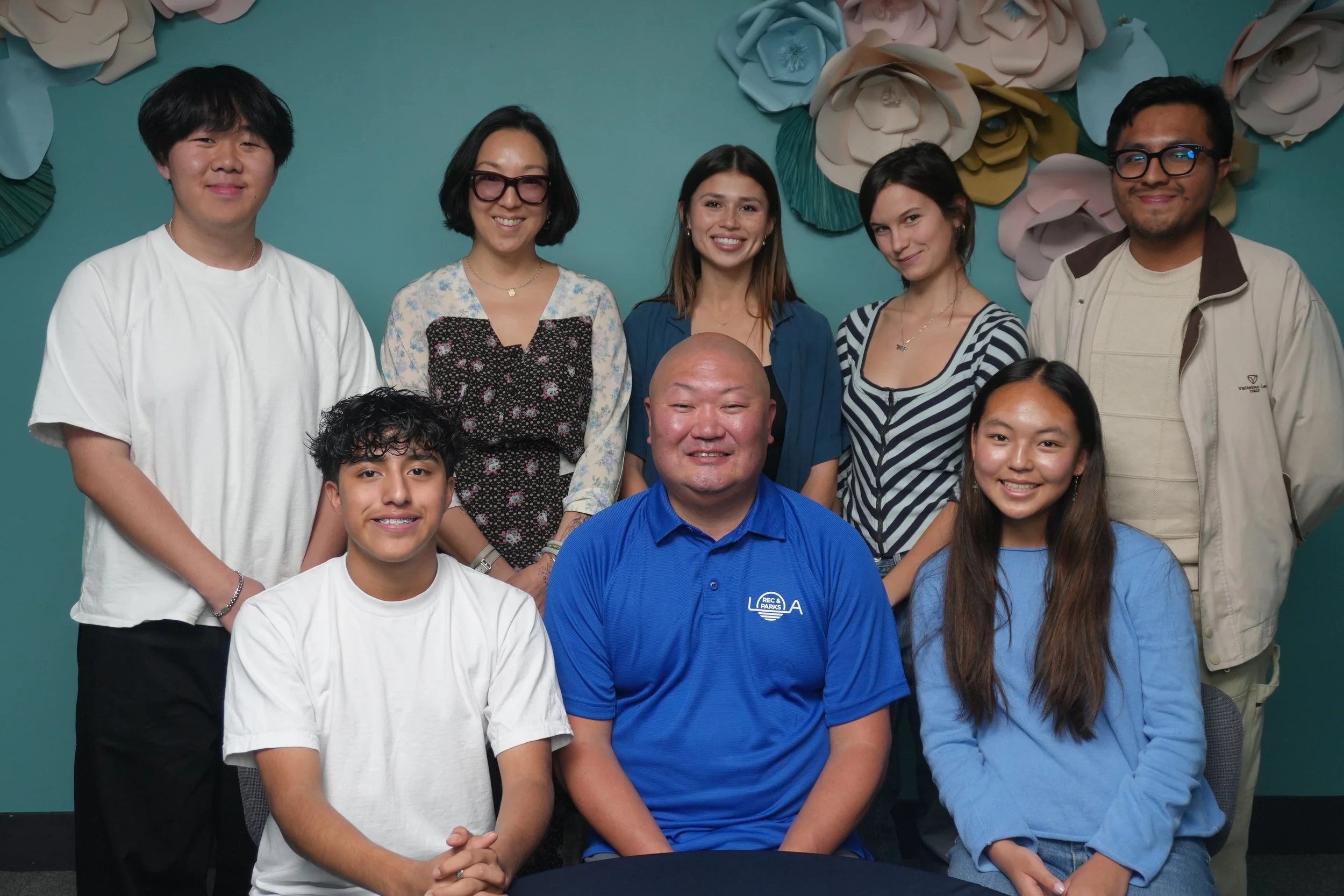
Jimmy Kim
Jimmy Kim is a Korean American born and raised in Koreatown and the first Asian American General Manager of the LA Department of Recreation and Parks. The son of immigrants, he found his path through a city youth employment program in 1995 — a moment that steered him away from trouble and launched a 28-year career in public service. Rising from junior lifeguard to emergency manager, he now champions equitable park access for all Angelenos, guided by the belief that parks offer the same lifeline they gave him growing up.
Redefining Public Spaces for the Future of Los Angeles
Interview by Sebastian Mecinas and Terin Lee
Could you start by telling us your name, your age, and where you were born? How do you identify?
My name is Jimmy Kim. I was born here in Los Angeles. I am 47 years old and identify as a Korean American male.
Tell us about your hometown. What area did you grow up in? What was your childhood like?
I grew up in Koreatown, Los Angeles, not too far from Western and Olympic, which is kind of the heart of Koreatown. My childhood was interesting. My parents are immigrants, but I was born here in the U.S. We didn’t have electronics, so I spent a lot of time playing outside. [There weren’t] a lot of parks near me; the closest park was Ardmore Park, which is now called Seoul International Park. As a youth, if I weren’t playing on the street, playing street ball or whatnot, I would walk to Ardmore Park. I remember going there with my grandmother a lot.
I grew up in Koreatown. At my [apartment complex], there were a lot of kids, so I’d hang out with them and have a little crew. I went to school locally as well. I started at Wilton Place Elementary School, then John Burroughs, and then went to high school at L.A. High.
Growing up, were you aware of your Korean identity?
Until I was in the sixth or seventh grade, there were a lot of Koreans around me. As I got into ninth grade, a lot of my Korean friends who lived where I did were moving away. They were moving to different parts of the city. A lot of Latinos were moving in, so around then, my friends shifted from being Korean to Latino. From then on, I was kind of ingrained in Latino culture. I mean, I would go to my friends’ quinceañeras! I was one of the very few Asian kids who could dance.
Yes, I identified as Korean, but because there weren’t a lot of Korean kids around me, I think I lost a little of that identity at home. Obviously, I spoke Korean, so I still had that touchpoint, but in terms of the people who were around me, I think they were all Latinos. I was the only Korean kid who hung out with people not within our group.
Were there any experiences that helped shape your point of interest in recreation and parks?
The reason I got into recreation and parks, or just the city, was really by necessity. I grew up in a time in L.A. when we were all on the streets. There were a lot of bad elements, whether it was tagging, gangs, or things like that. For a minute there, I was associating with a bad crowd. My sister, who’s three years older than me, was in high school and had gotten a job with the city, so she didn’t really know [what I was up to] because as you get older, your siblings kind of don’t want to talk to you. Then she was away at college, and I was doing my thing on the streets.
When she came back, I had gotten into trouble with the law, and she was like, ‘You need to figure something out. You need to do something that’ll get you out of that type of environment.’ She was working as a pool clerk in Griffith Park, and she said, ‘There’s a program called the Summer Youth Employment Program, which is through LAUSD. You should go into that program, [earn] learning credits for school, and you could have a job.’
I applied and got into the Department of Recreation and Parks as a junior lifeguard. Back then, we were getting paid $4.25 an hour, but that was a lot for me. I got started in the summer of 1995, and I immersed myself. I was there every single day, even when I wasn’t working, because a student could only work 20 hours a week. My sister worked there as well, so I would just go with her and be what we call “pool rats.” That’s what I was for the entire summer, and that really got me into the department. It was a job where I could [wear] shorts, be in the water, and be out in the sun.
How many siblings did you grow up with?
Just my older sister. My parents were very hardworking. I remember they would leave in the morning. They had different careers and opportunities, but later in life, I remember my mom and dad owning a liquor store in El Monte. They would go very early in the morning, and I wouldn’t see them until 8 o’clock at night. We would have dinner together, but during the day and in the early evening, it was just [my sister and me]. She was almost a mom [to me].
We had many fights back then. I remember that because my sister was bigger than me, she would manhandle me. As I got older, I remember a pivotal moment when she was going to discipline me, and I stopped her. I said, “You can’t hit me anymore.” After she graduated from college, she left for Korea to teach English. During those times, you start [to miss your] siblings. As a youth, I’d never have thought I’d have such a close relationship with my sister, but we spend a lot of time together. Our kids are fairly the same age. My oldest and her oldest are one month apart, so we engage a lot.
What was your parents’ story?
My dad immigrated to the U.S. around 1958. My mom immigrated in 1973, so their story, I think, is a little different from other Korean people who have immigrated to the U.S. in that they actually met here. When my dad immigrated here, he had about $40 in his pocket. The only place he knew where Asian people were was in Little Tokyo. So he actually went to Little Tokyo, got a job at a restaurant there, and lived above it. He said that he worked there doing dishes. Eventually, he started working for a bakery called Dolly Madison.
My sister was born in ’74, so he met my mom, I guess, when she came to the U.S. Obviously, a lot of Korean immigrants back then worked and sent money back to Korea to help their families. So the story I heard was that my dad and mom were going to leave for New York because she wasn’t really making much money here [in Los Angeles]. She was a banker, but she found [a housekeeping job] in New York, and it was going to be a lot more money. My dad fell in love with her and said, ‘I want you to stay here. I will take care of your responsibilities.’ They got married, and the rest is history.
You’ve worked in the Department of Recreation and Parks in various roles for a long time. You kind of touched on this already, but what first inspired you to join the department? What has kept you committed to this work for so long?
I’ve been fortunate in terms of longevity and the successes I’ve had working for the city. It was truly my first government job where I paid taxes. Man, it’s been 28 years since I’ve been with the department, and it’s just been an amazing opportunity for me. My sister was like, ‘You have to work for the city now. That was through the school, so you should work during the offseason.’ That was right after the summer. I asked my supervisor, “What’s available for me?” They said there were locker attendant positions.
I was a locker attendant at the local swimming pool in Koreatown. I was the guy there cleaning the toilets. I feel that job instilled really good working habits in me. If I didn’t clean well, I would have to go in and redo the work. So as I had to redo things, I remember thinking, Okay, I don’t want to redo this, so I’d better do it right the first time. I was looking at the pool and thinking I could [also work there]. [I’d done it] as a junior lifeguard, so I started working for the city proper after that summer in September.
In December, I decided [to try] being a lifeguard. I wasn’t a strong swimmer, but I was very, very motivated. You can tell if someone can swim by their technique, right? I always say that if you swim with your head above the water, you’re probably not a true swimmer. If you can swim with your head underwater, then you are. I was one of those guys with my head out of the water, so I wasn’t a good swimmer. But I had drive and had said I wanted to do this.
I trained really hard from December through March, really getting in the water and swimming, and then I became a lifeguard. I took the test in March or April; they have a really hard lifeguard academy, and just by sheer willpower, I survived. I was always the last guy to the wall. I would come out [of the water] and be dying because I was so tired. But I was able to pass the lifeguard test and started working in the summer.
Back then, there were so many lifeguards, so I was on reserve. I wasn’t even a top choice, but throughout the entire summer, I just made myself available. I would work not only around Koreatown but in the Valley. I would go to South L.A., just wherever I could get hours. I guess that was a good thing because that winter, when a lot of our lifeguards went to college, they picked up what they call off-season workers. I was able to [secure] a position. I was a part-time lifeguard for almost nine years, and then I was trying to figure out school because I had put it on the back burner.
I was fortunate enough that [the city] opened full-time positions in 2005. During my tenure as a part-time employee, I was doing a lot of special projects. I was putting myself out there, trying to gain as much experience as possible. In 2005, I had the opportunity to go full-time as an aquatics person and then worked my way up in the aquatics division.
There was a lawsuit that the city was dealing with in 2009 that had to do with the Americans with Disabilities Act [regarding] emergency response. I was in the right place at the right time, and one of my bosses was frustrated that this thing wasn’t happening for the department, so I kind of volunteered myself and said, “I think I could write an emergency plan.” He kind of looked at me and said, ‘Who are you?’ I was like, “I’m Jimmy Kim. I’m with aquatics.” He gave me an opportunity, and I took that and really ran with it.
In ’05, when they opened the emergency management position, I interviewed for it and got the position. So I was an emergency manager until about 2020. From 2015 to 2020, we were developing our department’s emergency response. I think what a lot of Angelenos don’t know is that in the City of L.A. Department of Recreation and Parks, we’re responsible for mass care and sheltering. During a disaster, we partner with the American Red Cross, but the Department of Recreation and Parks actually leads the emergency response.
When 2020 came around, through the grace of hard work and luck, we had just established our emergency management program. COVID hit, and in our emergency plans, the way it’s written is that the department’s general manager can delegate authority to the emergency manager. It just so happened I was the emergency manager, so when COVID hit, he [the general manager] delegated authority to provide all the leadership for the city, the department’s response to COVID, and the day-to-day blue-sky stuff. Then I handled all the emergency response stuff.
We shut down the city, but our department was still front and center because we had to provide shelter for persons experiencing homelessness. We opened 24 shelters. We were working very closely with the mayor’s office and public health, developing different types of protocols and responses. During that time, LAUSD also shut down, so a lot of our centers [became] alternative learning sites. We made our sites available to children who had nowhere to go, didn’t have an internet connection, and just needed access. We opened up, I want to say, 50 sites that were available for you to come for online learning, and all the process that we’ve done for that was really — there was nothing written at the time when I look back.
What are some of the most meaningful lessons that you’ve had throughout this journey?
The community impact and being able to change lives. I remember when I was a pool manager. That was part of my career trajectory. I oversaw a pool, and there were a lot of youths in the park who were kind of involved with the wrong people. I remember getting them to participate in our programs. Eventually, I was like, “Dude, you guys all can become lifeguards. You all can have jobs for the city.” I remember pulling them all in. There were about 20 of them, and then we recruited another 20. We had a mini training camp in the summer, and out of the 40 kids, about 25 of them became lifeguards.
That’s just impact. You took a kid who could have [gone down] a different path, and now they’re on a whole different trajectory. And that’s kind of my story, right? If I didn’t have this opportunity, or somebody to say there was an opportunity for [me], I don’t think I would be here with you guys. I would probably be incarcerated. It’s those types of moments, the impact that we [make], and even the programs we develop. As I’ve come up the chain of command and have the ability to give back, those are the moments where, even if it’s hard, even if it’s long nights, [it’s worth it]. There are times when I can’t be at my kids’ soccer games, I can’t pick them up at school, and I hope they also know that the things I do, the things that we sacrifice for, are not only for the family but also our communities.
How did it feel to become the first Asian American general manager of the department?
The impact wasn’t really about how I felt. It was all the hard work I put in that brought me to this point. As I started realizing my cultural background, I felt as though it gave me a platform to really show what city service looks like because of tradition.
Traditionally, in Korean culture or Asian culture, our parents want us to be doctors or lawyers, right? They don’t really think about city government. Being of Korean descent, I now have this opportunity to say, “Look at the amazing things that the city government can provide.” I owe my life to this department. I provide for my family because of this department.
That moment wasn’t about, Oh, I’m the first Korean American. It was more like I made it. As I started talking to other Korean organizations, I started meeting more Korean people in our sphere. I had the opportunity to provide a different look into city government for our Asian community; they don’t really look at government. That’s the job you should go for, right? It is just as important. It is just as satisfying.
What do you see as the biggest environmental challenges facing parks right now?
Well, we could talk about climate change infrastructure. Traditionally, those are the things we would think about, at least for me, from a recreation park’s perspective. I look at it from the perspective of global warming and the different impacts on our green spaces. I was an emergency manager, so I saw firsthand how climate change has impacted our communities, especially communities of color, where they often don’t have building ordinances [requiring] apartments to have air conditioning — heat, yes, but no air conditioning. We play a pivotal role in opening cooling centers and providing access. As a city, we are experiencing different types of environmental impacts.
How does the Department of Recreation and Parks help address that? As we confront climate issues, how are we preparing for the impacts of extreme heat, drought, or poor air quality?
We have a robust emergency management program that helps [us respond] to changing temperatures. We’ve also, to your point on air quality, opened air refuge sites within recreational park facilities. More importantly, we just finished a Park Needs Assessment (PNA). We hadn’t done one in over a decade, and this one was really at the community level. We gathered a lot of information in terms of where our neediest communities are and how it’ll help us define [our approach] as we look to the future.
We got all this data, like where our priorities are, so how do we shift our resources to make sure that we’re addressing some issues and impacts of climate change, air quality, low socioeconomic backgrounds, and park access? Ultimately, the goal of our department is for every Angelino [to have] access to a park within walking distance. Even for me, my walking distance was at least 15 minutes to get from where I live to Seoul International Park. The goal is to reduce that [distance] and give people access to green space.
You talked about the role parks play in climate resilience, especially for communities with limited green space, such as Koreatown. There aren’t many parks here. Can you elaborate on that?
The way we address that is by working with the community. Those listening [to or] reading this interview who live in L.A. understand the very high price of real estate. It’s very difficult to obtain parklands. We’re looking to work with our community partners and different advocates within our community to see how we can leverage the spaces we have to provide more access.
One thing we’ve endeavored to do over the last five years is to start a community school board program, which is opening up some LAUSD campuses on weekends to provide [access to] green space. So we’re working on that, looking at different ways to fund those types of opportunities, and obviously working with community groups that have spaces they want to turn into green space, so we can come in to support and provide programs.
From your perspective, why are parks so important for environmental justice and public health?
I’ve known this throughout my life, but when we talk about COVID and how many people came out to the parks and the mental health relief they got from just being outdoors, I think it’s telling about how important parks are. Just being in the park puts you in a different world. In terms of mental health, I think it provides a refuge from everyday life. I would love for more people to have access. There are things that we’re doing as a department to say, “Well, how do we bring the people who aren’t already there into the parks?”
How do you approach making parks more inclusive, safe, and welcoming for all?
It’s a partnership and collaboration because, as a city department, it’s really difficult since we’re not at every single park, right? But communities are. Listen to the community and the youth. It’s great to hear from the parents, but how about the youth and their experience? We have park advisory boards and neighborhood councils, so one thing I’ve done is to ensure that each of our boards has youth representation. How do we shift programming based on what the community wants? I could go in and say, “I think this is a good program,” but if I don’t hear from the community and I’m just throwing up programs, it won’t matter.
Can you share any projects focused specifically on underserved communities or youth?
[We designed] all our programs in the department to be equitable and accessible, but one program that we have, which is kind of our flagship right now, is called Play L.A., a program that we established in 2018. It’s the single largest [sports-related] donation sponsorship the city has. It’s a collaboration and partnership with the City of Los Angeles, the Los Angeles Organizing Committee, and LA28. The idea was that it was a pre-legacy investment in the city. It was $160 million over 10 years. This funding has allowed us to truly provide fair, high-quality programming for youth in Los Angeles. If you haven’t heard about it, we encourage you to go to laparks.org to learn about Play L.A. because it’s an amazing program. All our programs are $10, and that covers everything from aquatic-based to land-based — anything sports, it’s in there. We have archery, and we piloted equestrian last year. Ideally, as we get to ’28, the really strong programs will continue to maintain as a legacy of the 2028 Olympics.
What are some of your long-term visions for Los Angeles parks, especially as the city grows and faces new environmental challenges?
My long-term vision for this department is that we truly provide for our communities. I think our staff in this department love what they do. The passion that I have, I want to say 98% of our staff shares it. Many of them, like me, started at a very young age and worked up the chain of command, but it’s really about working with their communities. How do we give more resources [directly] to the parks department, and then leverage those resources so that our communities have safe, accessible parks throughout the city? Obviously, working with our elected officials to see how we can expand green space.
How challenging was it for you to get to the point in your career that you are right now?
They say hard work will get you to your goals, right? I absolutely believe that. It’s also just putting yourself out there. You could do a lot of hard work, but if you don’t put yourself out there or don’t have great leadership, it can be challenging. I know folks who are amazing and hard workers, but they don’t really put themselves out there, so they’re often in the background. I would dare say be bold. Put yourself in positions where it’s uncomfortable. I’ve been fortunate to be in those types of positions where I’ve said I could do it, or I was the guy raising my hand to volunteer. Take risks. Those risks, as long as they provide the outcome, will pay off in the long run. I’ve been fortunate in terms of the risks I’ve taken, where I volunteered, and where it brought me. Looking back, those have been some of the most rewarding moments in my entire career. It’s been an amazing ride for me. I have eight more years until retirement, and I hope to continue in my position for the next eight years.
They say, even if I’ve worked for the department, I’m a very outside-the-box thinker. That’s kind of what made me successful as I came up the chain of command. I really look toward the future and imagine: if we have the resources, if I’ve been a GM for three years now, what I could do in the next three years, the next eight years? How amazing we could do for our communities in the city.
What gives you hope about the future of L.A.’s environment and public spaces?
There is a very big interest in green spaces and parks. The youth come in and get energized and motivated by the things they can do that’ll really move the city forward, whether it be environmental or park space. I’m so excited to have these types of conversations so that other youth can see that there are opportunities to give back to their community and make a difference.
For the younger generation, what advice would you give to those who want to make a difference in their communities?
Just get out there and participate in community activities, whether through the park system or organizations [that serve] the community. Really get out there. I see more and more of that, which is inspiring to me because a lot of the time, younger youth want to see themselves, right? I’m an old guy now, so they’re like, “He doesn’t know what he’s talking about.” If there are other [young people] out there who are leading the way, it really makes a difference. Whether through volunteerism or working for the city, just get out there and give back to our communities. We make our communities and parks better. The only way to do that is to be part of that action.