

Lucy Hwang
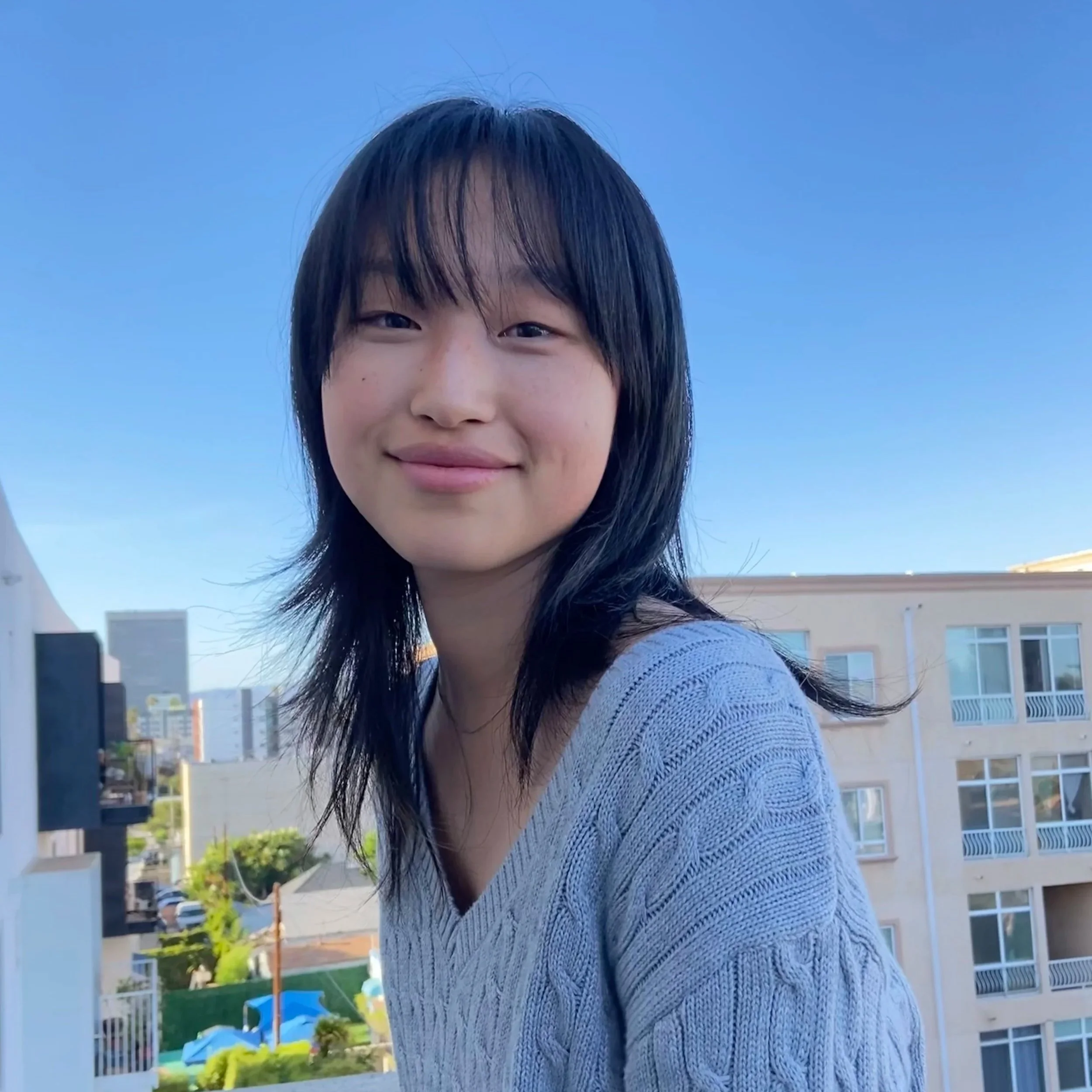
Lucy is a senior at Fairfax High School in Los Angeles, where she explores many of her interests. She loves learning history, exploring fashion, and long-distance running. She loves trying new things and has recently discovered her fascination with physics. She is president of the Peace and Social Justice Club and captain of the track and field and cross country teams. She has also learned to be active in her community, mainly as a part of KYCC’s high school BRIDGE program and the Hope Global Outreach Foundation. Born and raised in Koreatown, she has never learned about its history. However, through the years, she has learned to cherish its prominent culture and diversity. Through this program, she hopes to hone her writing skills and explore undiscovered aspects of her hometown. In the future, Lucy hopes to study economics and history at the University of Chicago.
Experiencing the City
Interview by Dale Lee
Where is your hometown?
My hometown is Koreatown. I’ve lived here my whole life. So that’s a total of 17 years. I was born and raised here, so I don’t have any experience living elsewhere. Even in Los Angeles, I have always been in Koreatown. That’s more so because when my grandparents first moved here, they decided to settle in L.A., and my parents followed them. It’s just been like that ever since.
Do you have any fond memories from your childhood in Koreatown?
I lived in the same apartment as my grandparents. When my parents and grandpa went to work, I would be with my grandma all the time, and we would often walk to the park together. Our apartment was near the [Vermont Avenue] area. There used to be a Mexican grocery store, and I remember her taking me there. There would be some foods that I never knew about, and she would buy me candy there.
Are there any memorable stories that your parents told you about their immigration to Los Angeles?
When they first came here, they moved directly to L.A., and they settled in another apartment before I was born. All I know is that they had different jobs than they do now. My mom used to work in skincare, so she had her own shop and practiced with a partner. After her training and all that, she was able to open her own shop and business. It was right next to that little mall, the Koreatown Galleria.
What do you think growing up in L.A. was like? Koreatown is pretty big.
I personally love the city. I would never live in the suburbs. People say that Los Angeles is the city with the most traffic. It’s so annoying, but I love the busyness, and I love seeing people all around. I think it would be even worse to walk on a street with no one on the road and just cars going by you. When I take the bus, just seeing everyone around me is nice.
Do you have any favorite memories related to the community in the city?
Well, one memory I have of the city is that it’s very easy to get around with my friends. You can go to one big place and then, five minutes later, go to this other big place. It’s very fun to have that in general, and I was able to experience the city more.
When I got into high school or even middle school — I went to Rise Kohyang Middle School — it was a very busy place. It’s on Vermont Avenue, near the subway station. So I think going out with my friends, getting boba, riding the subway to the Madang Courtyard, and just exploring on my own have always been a very fun part of my life.
Did you have any bad experiences in the city while on those trips?
No, I’ve never seen or experienced anything dangerous. I understand that the city can be very dangerous, but fortunately, I haven’t experienced anything like that.
What high school do you go to currently?
I go to [Fairfax High School]. It’s right by Melrose Avenue. It’s pretty similar to the experience I had in middle school. There are many vibrant shops. The Grove (shopping mall) is about three blocks away, and just about everything is there — a lot of shops, restaurants, and people.
If you could, would you like to switch to another school?
I wanted to go to John Marshall High School when I was in the eighth grade, but it was far away, so I decided not to go. Thinking back, John Marshall is kind of secluded from the entire city; it’s in a very residential neighborhood. I feel like my decision to go to Fairfax High, where it is very vibrant, was a good one.
I’m on the track and field team and the cross country team [at Fairfax High School]. It’s been amazing because the schools around me don’t have as many sports opportunities as Fairfax does. So I’ve been to a lot of [track and cross country] meets, which I didn’t even know was possible in middle school because Rise Kohyang was on the second floor of an office building with very, very limited space. Fairfax High has a huge campus, so being involved in sports has opened up my understanding of the city, what’s around me, and the opportunities I can take advantage of.
How does your race or ethnicity apply when you’re fitting into the community?
From my experience, most of the people in Koreatown that I’ve encountered are either Korean or Hispanic. I do know that in the schools that I went to, there were a lot of Korean cliques, and they hung out with people of the same ethnicity. I think, just with friend groups and exclusion in general, it’s very prevalent in Koreatown. Others’ experiences living in other areas of the city are very different because Koreatown is so condensed with people [of the same ethnicity]. My friend goes to school about 40 minutes away [from Koreatown], and her experience is totally different. The ethnic diversity of her school is very different.
What’s your ethnicity? How did that affect you, and are you tied in with the culture?
From what I know, I am mostly Korean. I’ve been speaking Korean ever since I was little. My parents are fully Korean speakers; they do not speak English, or at least they didn’t when I was growing up. Not that they’re fluent now. My grandparents didn’t [speak English] either, so Korean culture was around me all the time, especially with food. As you know, there are many Korean shows and news channels on television, so it was around me all the time.
What would you say is your favorite part of Korean culture? Do you have any favorite holidays or traditions?
My favorite part of Korean culture is the food. My family used to always go to our grandparents’ house every New Year’s and Christmas. My aunt and uncle would come over, and it was always a gathering about two or three times a year. We would all just make food, eat, and hang out.
Do you have a favorite place in Koreatown?
My favorite place in Koreatown is anywhere I’m with my mom. I don’t have a distinct place, but doing anything with her, even if it’s going to the market or just driving on the road. Anywhere with my mom is my favorite place.
What do you think has been the most challenging part of living in Koreatown?
The most challenging part is not being exposed to other ethnicities and cultures. Growing up, it was always Korean or American culture. I think I would have loved having different friends of other ethnicities and learning about what they eat, how they celebrate, and how it differed from or was similar to my own.
What was your experience with COVID, and how did you deal with some of the situations that came out of it?
My grandpa died because of COVID. My whole family had COVID, and I think it has been hard. The main hardship with COVID has been [the impact on] family dynamics.
What do you think you learned from the experience of COVID?
I learned that things just happen, and you have to deal with them. Especially with school and, again, my grandpa. Sometimes you can’t help it and just have to deal with it. I think that’s the best way I can put it.
Is there anything that’s giving you comfort during this time?
I don’t have a specific hobby I’m usually confined to. Actually, I’ve been camping a lot this summer, so that’s been great. I went backpacking for a week in Big Bear. I was with new people I’d never met before, and we were pooping in the woods. It’s given me a stronger appreciation of nature.
Koreatown is very accessible with its proximity to a lot of places in Los Angeles. You could easily go to downtown L.A. or the Westside. In general, L.A. has a lot to offer, and it’s great how Koreatown is in the middle of that and offering this strong sense of community. You can easily find an urban area without such a dense hotspot of a single culture. Yeah, being in that is really nice.
Have you seen Koreatown change in any way over the years?
I’ve seen a lot of gentrification happen, with a lot of new buildings being built. There’s always construction going on somewhere, which you can easily expect in any city, but it’s definitely increased over the years in Koreatown.
What is the toughest part of your life right now?
I’m currently going through college applications, and I would say that’s the toughest part of my life right now. I think just the experiences I have [right now] through school and making sure I’m able to go to a good college are probably the biggest problems I have right now.
What’s your dream university?
I want to go to the University of Chicago. I want to leave California. It’s a big state, and I understand I haven’t experienced all of it, but I think just being somewhere else and kind of living independently would be a very, very cool experience. The University of Chicago offers me that because it’s in a big city, it’s a great school, and I know that it has a large Korean community too. When you look at schools, they each have their own type of student. I think Chicago really fits for me.
What do you think you would miss about Koreatown if you moved to Chicago?
I would obviously miss my mom, and I would also miss what it looks like [in Koreatown]. Like when you drive around and pass by the Galleria or Madang Mall. You know, just the Western and Wilshire areas in general — I would just miss it.
What is the one food that you will miss?
I would miss a really good sundubu-jjigae (순두부찌개 — Korean spicy soft tofu stew). I like the little packets that they sell it in, but I want to learn how to make it on my own.