

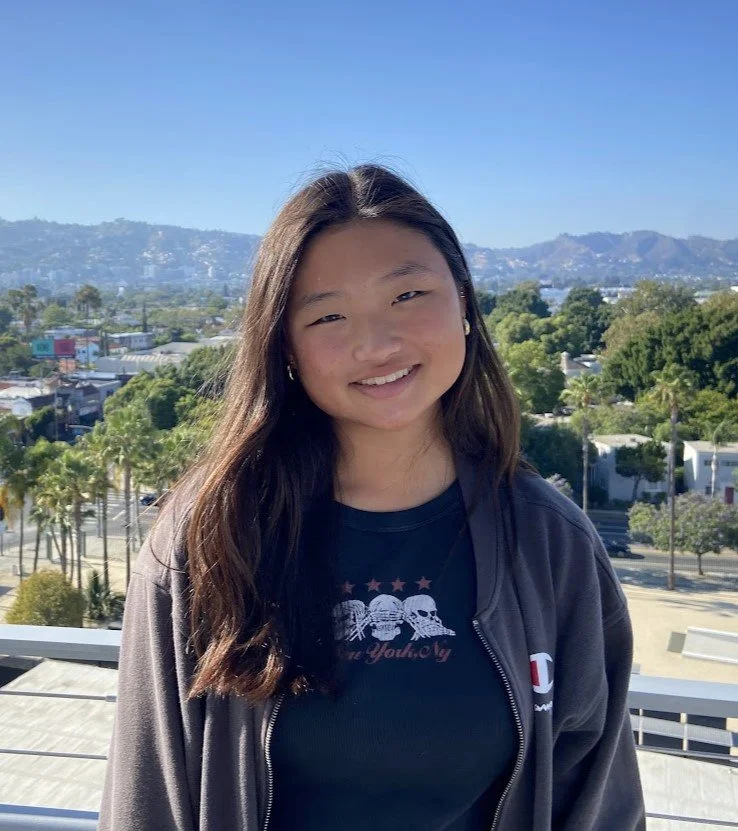
Nadia Cho
Nadia is a sophomore at South Pasadena High School. She has always had an interest in her Korean heritage and wanted to explore Koreatown’s past to help her reconnect with her family and culture. Food has always been a center of interest when it comes to her memories of Koreatown, and she is excited to dive deeper into the topic. Nadia enjoys learning about business and competes at the state level in several business competitions. She hopes to pursue business management on a professional level. In her free time, Nadia swims and plays water polo for her school’s varsity teams.
Between Two Worlds
Interview by Chase Nam - November 22, 2022
Where would you say your hometown is?
My family moved around a bit when I was a lot younger, but I spent all of elementary school and most of middle school in this suburb of Los Angeles called South Pasadena. It’s a really small town, and I still go to school there. I would say it’s my hometown.
Do you go to South Pasadena High School?
Yes, I do.
Do you have any connections to Koreatown from your childhood? Have you lived there?
My paternal grandparents worked in Koreatown for a very long time. [They relocated there] a few years after leaving Korea in the late 1960s. They first went to Texas, but a few years later, they moved to Koreatown. My dad grew up partly in Koreatown. My grandparents started an accounting firm there, where they worked until a few years ago, so it’s quite an old firm. My dad still works in Koreatown; he actually works for the Koreatown Youth and Community Center (KYCC). He’s in the same building where we (Koreatown Storytelling Program participants) meet.
Do you go to any other places in Koreatown?
I don’t go to Koreatown that much because the area I live in is surrounded by other busy suburbs like Pasadena or Alhambra. We’re also kind of close to downtown, but I don’t go anywhere after KSP. There have been several times over the past three or so years that I’ve gone to KYCC events, gone out to dinner, or taken family members out to dinner [in Koreatown] — that’s our go-to.
Is your dad’s work at KYCC the main connection you have to Koreatown?
Probably. I don’t really have many family members who live in Koreatown. Most of my [family] on my dad’s side lives in Orange County. My mom’s side is on the East Coast, near the New York area. My dad is really the only connection I have in Koreatown.
You talked about meeting with extended family members [in Koreatown] for dinner. Do you have any significant memories from that?
Well, one of the funniest and probably most prominent memories is from when I was really little. I would get random fevers, and my dad couldn’t take time off [from work to be with me] at home when I was sick, so I would have to go to his work. Back then, he still worked for my grandfather, so it was fine for me to be [there], so I would just kind of hang around in his office. I can’t really speak Korean, so his co-workers — these older ladies — would try to talk to me, and I would just kind of nod along.
Do you think living mostly away from Koreatown influenced your Korean-speaking ability or connectedness to Korean culture?
For sure. Actually, there’s this place called Young Nak, and when I was younger, my parents enrolled me there to learn how to speak Korean. I hated it. For one, my parents’ Korean isn’t super good because their parents worked a lot, so they didn’t get to speak to their parents in Korean. They couldn’t really help me with anything, and all the other kids [at Young Nak] spoke Korean well — they spoke it at home. I just kind of got tired of [studying Korean]. My brother and I had to [attend Korean language classes], but we complained so much that they finally let us quit.
My brother and I have talked about this several times over the past few years. We used to live in Fullerton, which is a very heavily populated area full of Korean people. We’d say things like, “Oh, if we had just stayed there and hadn’t moved to South Pasadena, where there are [fewer] Korean people, we probably would have been able to speak fluently or at least speak some Korean.” Fullerton is sort of similar to Koreatown in that way.
Could you give me a loose timeline of where you lived and moved during your childhood?
I was born in the Bay Area. When I was about 2 years old, we moved down to Fullerton, and I stayed there until I was around 4. Then we moved to South Pasadena, and I spent most of my time there until around April 2020, when we finally moved to L.A. I’m actually living in a neighborhood called El Sereno now, but it’s not super far from South Pasadena or downtown.
Since you live in El Sereno but go to school in South Pasadena, were you already going to South Pasadena High when you moved?
I’ve always gone to South Pasadena schools. I went to elementary and middle school there. My mom is a teacher at the middle school. She teaches sixth-grade English and English Language Development (ELD), so we were able to move away and still go to South Pasadena schools because she worked for the district and didn’t want me to go to the local public school.
Do you know why that is? Did you know people from South Pasadena High School, and did that make you want to stay?
Yeah, it’s a really small town, and I’ve been there since kindergarten. I kind of know everybody since there are three elementary schools and one middle school. Once I got to middle school, I started meeting everybody in my grade, and not too many people moved away or transferred in. I know almost everybody in my grade.
Is that part of why your parents didn’t want you to go to another public school?
I don’t think they would have minded that part. To be honest, I think it’s because the area I’m in is kind of gentrifying right now. The local public school, which is part of the Los Angeles Unified School District, isn’t necessarily that good.
Since you don’t go to school in the neighborhood where you currently live, do you have any connections to it besides living there?
My current neighborhood? No, it’s mostly that we decided to live here because it wasn’t too far.
Moving around a lot in your childhood can impact what you consider your community or hometown. It seems like South Pasadena is mainly where you know many people. Is it hard to define your hometown since you’ve been moving around so much?
I don’t think so. Even though I was born in the Bay Area and then moved to Orange County, I was too young to remember most of it. I would have preferred to move around a little bit more because South Pasadena is so small. It feels like you’re in a bubble since there’s no one new to meet.
Do you think South Pasadena has a large Korean population compared to places like Koreatown or Fullerton?
Koreatown has a really large Korean population. South Pasadena also has a lot of Korean people, but it’s not really a Korean community. It’s very mixed. I would say it’s like 60% Asian, 30% white people, and 10% everybody else, but most of the Asian kids are Chinese. Maybe a good chunk of them are Korean if I’m including the Wasian (white and Asian mixed) kids. There’s a large Korean population, but there’s also a pretty large biracial population — we call them Wasians. There are a lot of mixed [white and Korean] kids, so there are a lot of Korean Americans.
Do you think the demographic in Koreatown would have been better for you? Would you have preferred to grow up in a community where there were a lot more Koreans?
I don’t know whether I would have liked it or not. The Korean kids who came from Korea when they were a little younger or those whose parents are not very Americanized — I’m not great friends with any of them. They all seem pretty nice, but again, it’s just a cultural difference. Honestly, I think I would have been fine either way, but I would be a different person.
Were both of your parents born in America?
My mom was not, but she came to the U.S. as a toddler. My dad was born here and can speak fluent English. Both of my parents speak English fluently. My dad’s English is perfect since it’s his first language. He doesn’t speak much Korean, but he can understand it. He’ll just respond in English. My mom’s Korean is a little bit better because it’s her first language.
Did growing up with parents who were a little more Americanized than those who came from Korea later in life have a big impact on you?
I have a couple of Korean friends, which is kind of funny because they’re more Americanized than Korean. One of them is Korean American, and the other is pretty Americanized. Her mom is also pretty Americanized.
I feel like we have what my brother likes to call FOBs and ABCs, which are mostly Chinese terms, but he applies them to all Asian people. FOB [stands for] fresh off the boat, and ABCs [stands for] American-born Chinese. I have a lot of Chinese friends as well, and they’re all ABCs, so it’s different trying to connect with Korean people who are not as Americanized.
We recently switched churches to a more Korean church last year, so I’ve had the opportunity to make friends whose families are more connected to Korea. It’s been interesting talking to them, and you can definitely tell a difference just in the way that they act.
Was there a specific reason you switched churches?
Being out of Koreatown and having Americanized parents has left me with this cultural disconnection. I have a huge language barrier with my grandparents on my mom’s side. They don’t speak any English. My grandparents on my dad’s side speak really good English. I just kind of respond in Korean, and I don’t understand. So I feel like I missed a lot, language-wise and culturally, just by not being in a community with a lot of Korean people.
Was it your decision to switch churches, or was it more of a family choice?
It was probably my parents’ [choice] because we had been living in a very Korean place, like Fullerton, where there were a bunch of Korean people. My parents decided to move closer to downtown L.A. for work.
I don’t know if they specifically chose an area where they thought, ’Oh, we want our kids to go somewhere more diverse.’ I think they didn’t really consider other areas that have a lot of Korean people in them. The other place they considered [moving to] was Culver City, and I don’t think there’s a huge Korean population there. Maybe they did that on purpose, but I never really asked.
You mentioned a disconnect growing up with more Americanized parents who are Korean, even though you are 100% Korean. Do you think that’s a bad thing?
I think it can be both good and bad. Well, it’s kind of sad to think about. My entire family is Korean, but just my brother and I have this disconnection. At the same time, I feel like it’s allowed me to take different perspectives on things.
Is this what brought you to KSP? To try to connect with the Korean community?
Yes. I was also influenced by my dad working at KYCC. I met [KSP Program Director] Katherine Kim as well. I was really little, but I first remember meeting Katherine at one of my dad’s friend’s parties. [His friend] has a Mardi Gras party every year, so we always like to come along. When I met [Katherine Kim] last year, she told me about the program she ran, and I found it really interesting.
Are the parties you mentioned a mix of people or mostly Koreans?
It’s like a mix of people. I think there were a lot of KYCC employees, but I didn’t really pay attention because it was mostly adults.
Are there any places that you feel are important to you in Koreatown?
We’ve gone to a bunch of restaurants, but there’s this fairly new one called Quarters. It’s on a street where there are a lot of other shops. It stands out among other Korean restaurants, and I’ve been to so many. It’s an Americanized place — very modern and young. If you go there and stand outside, [you’ll mainly find] non-Korean people waiting in line, and they are mostly under the age of 30. Pop music is always blasting out. I just felt like the vibe was really good, and the food was very authentic. All the employees there were Korean, even though the customers were not. Afterward, it’s really easy to wander into different shops and get bingsu (빙수 — a Korean milk-based shaved ice dessert) or something.
Is this a place you go to often?
No, I find it a little bit overindulgent. I’m sure my parents do as well, so it’s only on rare occasions.
Is the food there Korean?
It’s a Korean barbecue place. The galbi (갈비 — Korean style short ribs) is really good, and the banchan (반찬 — Korean side dishes) are pretty good too.
Is it mostly traditional Korean food or Americanized?
It’s a little bit Americanized. [The restaurant serves] LA galbi (a lateral cut of marinated short ribs), so I would say it’s a little bit Americanized. At the same time, I don’t think many places serve Americanized Korean food.
Do you like that aspect of it?
A little bit. I enjoy both authentic Korean and more Americanized food.
Besides Korean restaurants, are there any other types of restaurants that you or your family particularly enjoy?
I feel like we used to go to numerous places, like The Dragon, where there are dols (돌/돌잔치 — the Korean first-birthday celebration). There was a period in my life when I was going to a bunch of dols because all my second cousins were having babies at the same time. We used to go to places like that a lot. We also used to go to Park’s BBQ a lot.
Is food one of the things you enjoy most about Koreatown?
Probably. I wish it weren’t, but yeah, for sure.
Are there any other aspects of Koreatown you enjoy?
I like people-watching in Koreatown. It’s interesting because as you go into different neighborhoods of L.A., it’s almost like being in a different country because L.A. is so diverse. I people-watch even when I’m in other neighborhoods, like in Little Tokyo or even where I live now. I just like to pay special attention to the people around me. I want to see what they look like, what they’re talking about, and what language they’re speaking in. I find that interesting, especially in Koreatown, because I feel more connected to that neighborhood.
Why do you feel more connected to Koreatown?
I’m Korean, so I feel more connected in that way.
Well, you say you enjoy the diversity of neighborhoods in L.A., especially Koreatown. Besides being more connected to Koreatown, do you think Koreatown is more diverse than other neighborhoods you’ve been to?
I would say so. For me, it’s always like this review. But it’s always kind of a shock to me to see non-Asian people in Koreatown. Just because when I was younger, I thought [Koreatown] was a designated spot for Asian people to live, but the name of the town is a little misleading.
Do you feel more connected to Koreatown by participating in KSP?
I would say so. It’s only one hour every other week, but everybody else has some connection to Koreatown. It’s been interesting to hear their stories, and just being there kind of reminds me [of the past].