

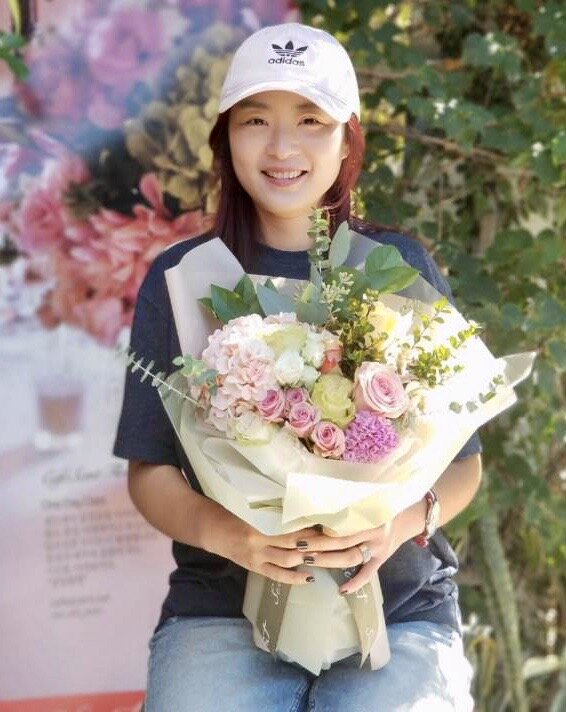
Sara
Sara S. is a 42-year-old mother of two daughters: a high school freshman and a high school senior. In 2002, she immigrated to Honolulu, Hawaii, with her husband from South Korea to continue her studies at Brigham Young University. After living in Hawaii for several years, she moved to Los Angeles, first settling in Burbank and later in Koreatown. Despite being a single mother, she decided to pursue her passion in the clothing industry and is currently working as a patternmaker in downtown Los Angeles.
Interview by Crystal Yoon
Where is your hometown?
My hometown is Seoul, South Korea. Seoul is the capital of South Korea. For a simpler comparison, Seoul is like California or New York. It’s the center of South Korea, as it’s the most developed city. What I love about Seoul is the shopping streets, such as Hongdae and Myeongdong. Each street has its own trend and fashion, and people are usually more attracted to one street depending on their style.
I remember going with my friends before coming here, and it’s one of the best memories I have of living in South Korea. I finished college in South Korea and was working for a company there when, coincidentally, I met a friend who introduced me to an opportunity to study abroad in America. I applied first, and when I got accepted, I decided to take the chance. That’s how I came to America. I was very excited about this opportunity because America was way more developed and modern than Korea at the time. America seemed like a place so distant from me, so when I got the chance to come here, I took it without hesitation.
I first settled in Hawaii and attended Brigham Young University. I enjoyed my experience at the university. It was a really different college environment than I had experienced in Korea. The professors were very nice. I enjoyed their lectures. Different from the university I attended in Korea, the classes were filled with more discussions, and we were given a lot of freedom. I made a lot of new international friends from different countries who were very nice to study with. One challenge I faced was speaking English, but I couldn’t avoid it. However, since the people with whom I studied were mostly international students whose first language was not English, we didn’t judge when another person really couldn’t speak English. Our grammar and vocab were hard to understand for others, but for us, we understood each other without any difficulty.
Being away from my hometown wasn’t always enjoyable. For the first six months, I often felt homesick and struggled to adjust to the new environment. It took me a year to fully adapt to American culture and the environment. One thing that helped me get through this new change was visiting my hometown. After living in America for about a year, I visited my hometown for the first time, and after that, I felt ready to live there. I do sometimes miss my hometown because that is where all my firsts happened: my first home, my first college experience, and my first job.
Do you live or work in Koreatown?
I live in Koreatown right now, but I did live in Burbank before. Burbank is a lot quieter than Koreatown, and there weren’t many Koreans when I lived there. I often felt lonely because I didn’t have family members or friends whom I could lean on. After living in Burbank for around a year, I decided to move to Koreatown after inviting my family to come to America. For them to live a more comfortable life, I thought it would be good to settle in Koreatown, a place most similar to South Korea. Living in Koreatown, they wouldn’t necessarily need to speak English, which I thought would make the adjustment a lot easier.
Although it was very challenging at first to support the whole family, everyone started adjusting to their new environments by taking jobs and helping out the family. My mother works in a restaurant in Koreatown, but as of now, her place has had to shut down. I can’t imagine another place our family would have decided to live other than Koreatown because of its convenience and familiarity.
My job has changed a lot after coming to America. My first job was at an eyeglass company, where I was in charge of data entry. Though I did work there for five years, I wanted to try something that I had a genuine interest in. My dream was to be a designer, as I always had a passion for the clothing industry. However, starting at a much older age than others, I decided to learn patternmaking, which was similar to designing. I got in contact with a teacher who had a lot of experience in this area and learned everything related to patternmaking for a year. I got my first job as a patternmaker in downtown [Los Angeles] and am still working in this position. I love how I can be part of the clothing-making process. My job is to make the framework of the clothing.
I use a specific computer program to get all the dimensions and parts of the clothing. We also use a specific printer and thicker paper to print the design. I usually patternmake clothes, but because of the coronavirus, our company had to make masks, which was a new experience for me. I would never have imagined making masks, but we have to constantly be aware of people’s needs in the fashion industry. Masks are essential now. The fact that I was in charge of making masks to help fight the virus made me think of how meaningful and important my job is.
What are your thoughts on Koreatown?
As a person who has lived outside of Koreatown, I can say that it is busier and more crowded than other areas. In Koreatown, since everything is close by, it is convenient and comfortable. There are many markets, restaurants, and stores. However, I do feel like Koreatown is not the safest place, but I am overall satisfied with living here.
Having lived in Koreatown for more than 10 years, I haven’t noticed any significant changes. When I first came here, I was shocked because, compared to other areas, I felt like Koreatown was not developed. However, as Koreatown is expanding its influence, many people have started to gain interest in the area. Recently, I have seen a lot of remodeling in the area and am starting to see the changes.
Along with these positive changes, one event that stood out to me while living in Koreatown was the incident with the people living in Little Bangladesh. When the people of Little Bangladesh invaded Koreatown, the Koreatown community united to prevent this action. The majority of the people living in Koreatown participated in the ballots. I was amazed to see how, in a time of difficulty, people of this community came together to preserve its history and culture.
Where is your favorite place in Koreatown?
My favorite place is the Olympic Galleria market or the shopping mall. I go to the mall at least once a week because it’s convenient. In this one building, there is the market and the bank, as well as several clothing shops, so it is very easy for me to get things done in one place. I specifically go to the second floor to shop at the Korean clothing shops. I like to buy my clothes from Korean stores because they fit my body a lot better than American brands. There are around four or five stores here. I could spend hours here just window shopping.
What has been the most challenging part of the quarantine?
The most challenging part is being forced to live a completely different lifestyle. I can’t go out without facing restrictions. Our family can’t eat out and shop like before. I could not work for a long time, so I had no source of income. Because of the coronavirus, our company was forced to cut down around 30% of its employees. Luckily for me, I was just forced to rest because of the mandatory shutdown. Not being able to work was the most difficult, but we were lucky to get some financial aid from the government to help us recover.
Has this experience changed you? If so, how?
Because of this experience, I felt much more grateful for the freedom given to me before. Before all this happened, I could go places freely and meet people without feeling worried [that they might] have the virus. Usually, I enjoyed meeting people, eating at restaurants, and our family would travel to different places. However, [given the current] circumstances, it’s difficult to go outside. I have learned to be more grateful for what I have and not to take things for granted now.
If the quarantine ended tomorrow, what’s the first thing you’d do?
If quarantine ended tomorrow, I would love to go to church. Since churches are usually crowded, it has been hard to open. Although many churches are providing online services, it’s not the same as physically going to church. Also, I would definitely want to travel. Our family likes to go to different places or even go on drives, so that’s what I would want to do.