

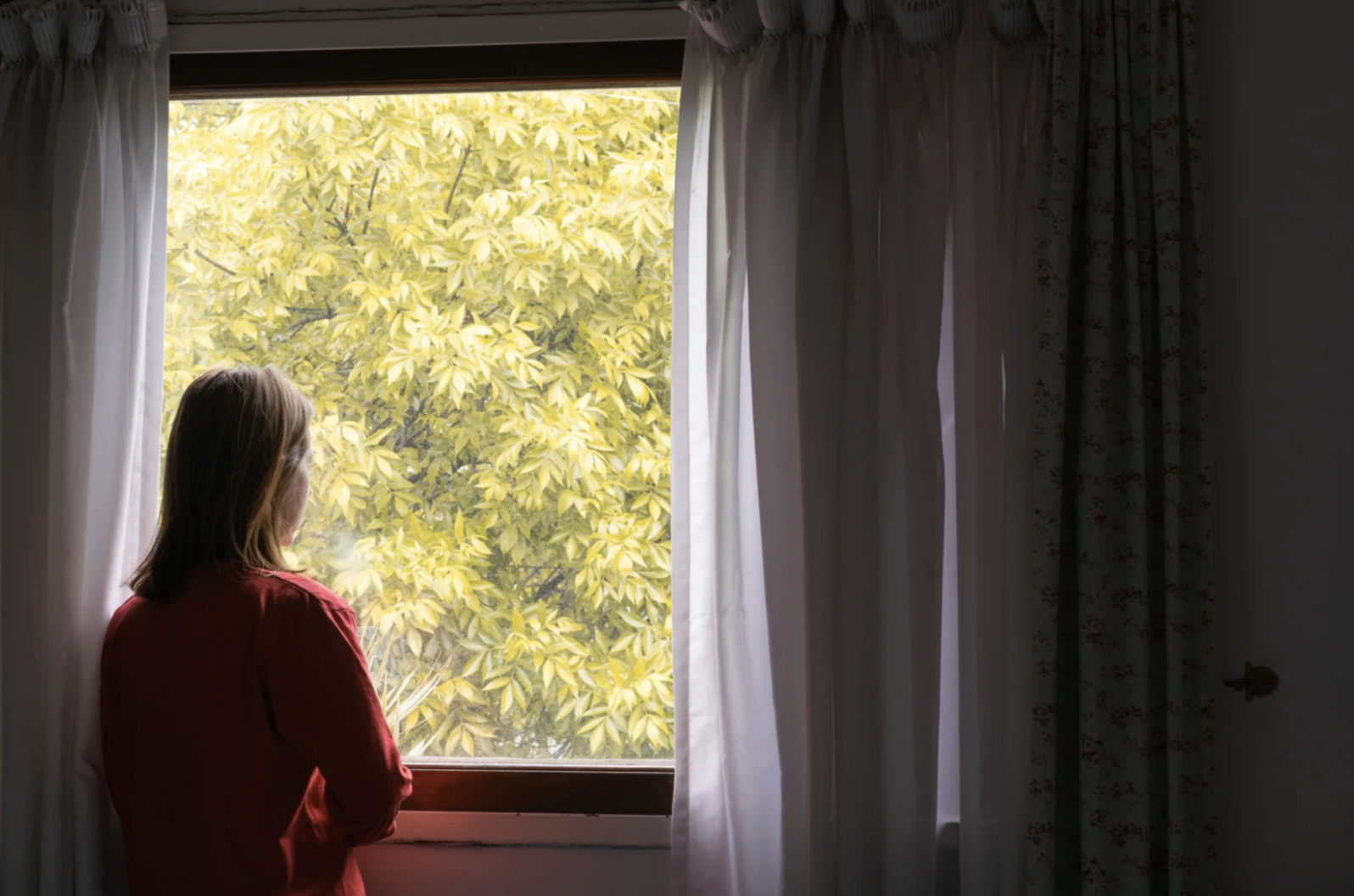
Mirna
Mirna is a 64-year-old Salvadoran American woman born in the Republic of El Salvador and now living in Pico-Union, Los Angeles. Her son started using substances at the ripe age of 15. In this interview, she recounts her son’s struggle as well as her own thoughts on substance use and accessibility and awareness when it comes to recovery services. Today, Mirna, a senior leader on KYCC’s prevention team, advocates for a shift in how society views those struggling with substance use, pushing for more compassion and a collective responsibility to protect and guide local youth.
Beyond Our Own
Interview by Anderson Pastor, Bisma Kashif, Esmeralda Tay
I would like us to start with your name, age, and where you were born.
My name is Mirna. I was born on February 10, 1961, in the Republic of El Salvador.
How do you identify?
I’m a woman and Hispanic.
Where is your hometown?
I was born in the Republic of El Salvador, where I grew up in the department of Santa Ana.
Do you have any hobbies? If so, what are they?
I have several. I love reading. I also run with the kids from Students Run Los Angeles (SRLA).
I’d like to talk a little about your family. Do you have a partner?
I have a husband. We have been married for over 34 years.
How many children do you have? Do you have any pets in your family?
I have four children. Yes, we have four pets: two puppies, Pepper and Bella; a kitten called Michi; and a cockatoo called Rosco.
Did you have any role models or idols during your childhood?
Yes. Ironically, my grandfather was an alcoholic, but I feel like he was the person I loved the most when I was a child because he was the only one who was loving. Even though he was an alcoholic, he always showed me affection.
Did you have any dreams as a child? What did you want to be when you grew up?
Yes, I wanted to study haute couture, high-fashion design.
How would you describe your childhood?
Sad.
Do you have a favorite childhood memory?
I have very few.
When you’re tired after a difficult week, what do you do to unwind, relax, and feel better?
I like to go for walks, hikes, and to the beach.
As you know, this project involves interviewing people who have experienced substance use and have gone through a recovery process, as well as their family members and professionals in the field of recovery, to learn from their experiences. We thank you for your bravery in addressing such a difficult topic. We’d like to start this round of questions by asking you to tell us a little bit about your son.
My son’s name is Abner. He was born in 1982. He was a very affectionate child. He grew up here in Los Angeles. I always talked to him about drugs. I always told him not to get involved with drugs. He was even in a program called something like “Just Say No.” Well, I don’t remember exactly what the program was called; I think it no longer exists. I didn’t know he was using, but he later confessed that he started [using substances] at school when he was 15.
What was his childhood like?
I think my son’s childhood was a bit rough because when we came here, his father had already been in this country for many years. By the time we arrived, his father was living a life of alcoholism and drug addiction. He inflicted domestic violence on us. The time we lived with him was about four years — four very bad years.
Do you have a favorite memory with your son?
I have many. We’d eat together. He always liked the food I made. We’d go out together, shop, and do activities. We did everything together.
Before he confessed that he was using substances, did you notice that your son was already using? Did you suspect it?
Yes. He changed a lot. He went from being a sweet child to a sad, angry young man. He distanced himself from us.
Do you think there was any moment or experience in your son’s life that led him to use substances?
Most likely, but I don’t think it’s always the case. Not everyone who suffers takes the same path. I believe it’s a personal decision. Your environment and the influences around you can push you toward that path.
Do you know what kind of drugs your son used?
As far as I know, he started with marijuana, but he said that marijuana was just a gateway to other drugs. From what I know, he used crystal meth, but I don’t know what else.
When your son received help, did he ask for it voluntarily or realize he had a problem?
No, my son was almost always defensive about his addiction. He always told me he had everything under control. He said that he would never hit rock bottom.
What kind of treatments or services did your son receive?
He was in Narcotics Anonymous.
How was his experience with the treatment?
At first, it didn’t work. It was hard; it didn’t help him. He spent a long time on the streets and faced many problems.
When you were going through such a difficult time, did anyone else notice that your son had a problem or try to help him?
Everyone in the family noticed, even my younger son. When people start using drugs, they seem to have no awareness and don’t care what people say or the suffering they might cause others.
How did your family react when they found out your son started using substances?
Most of them stayed silent, but my youngest son was angry with him.
Did anyone offer you help during that difficult time?
I have a friend — we’ve been friends for many years — and in terms of having someone to talk to and share my problems with, he has always been my support in that sense.
Did anyone else try to help your son?
Many people tried to help him.
How did your son receive that help?
We sought it for him. I was in a 12-step program called Emotions Anonymous. There, they told me how to find help for him. I went to many places, including an organization called Mothers of Addicted Children. I went to so many places looking for help.
When you offered him this help, did he react poorly?
He basically always reacted negatively. He would say he didn’t need help and that he had everything under control.
How did you feel seeing your son struggle with substance use?
That’s a very difficult question to answer. No one besides a mother who has gone through the same situation knows the pain of seeing their child destroy their life.
What helped you cope with the fact that your son was using substances during that difficult time?
One thing that helped me was getting closer to God, my church, and the 12-step programs. They helped me a lot.
Did [your son’s struggles] affect you mentally or personally in any way?
It affected the whole family. Yes, that kind of stuff really affects you.
If you could share a message with your son, what would it be?
My son is incarcerated at the moment. He hasn’t been out here with us for a long time. The message I always give him now — because now that he’s in there, he regrets everything and says, ‘If I had just taken even one of the pieces of advice you gave me, my life would be different’ — is that he has to be strong and keep moving forward, no matter what.
So that you remember where we left off, I’ll ask you some questions about your thoughts on substance use and recovery. What do you think about the stigma around substance use?
It’s definitely an important factor. When you don’t have any values, it affects your self-esteem. When you don’t have any religious or human values, you can end up falling into addiction.
How can we, as a society, reduce stigma and create a more compassionate environment?
Thanks to these programs here [at KYCC], we are achieving that because in our hearts, we want to help people, no matter if it’s just one person. We don’t look at people the way others do.
When people see somebody struggling with addiction, they judge them harshly. If it’s not their own child, they don’t care if they are rotting on the streets. Society doesn’t care about people who use drugs or anything like that. If they die on the streets, people are like, “Okay, let them die.” We are working to let these people know that they matter and that they can get out of that situation if they seek help.
What can we do to raise awareness?
I got involved in these associations more than 12 years ago, through [another] program. I got involved when I first arrived because I realized so many children would come home from school to an empty house. As a society, we should get more involved and understand that these children are not just our neighbors’ children but the responsibility of an entire society.
There should be more after-school programs so that kids are not left at home alone. When they arrive, the TV or video games shouldn’t be their babysitters. They should have someone to talk to, share their doubts and sadness with, or confide in if they were bullied at school or things like that. We need to be there as a society to look after these children.
Do you think the services and treatment options in your community are accessible to those who need them?
Sometimes. There are a few organizations, but not many. We need more community outreach so that people know we’re here to help. Above all, if we look at our area — this area around [Los Angeles] — there are very few rehab centers for people who can’t afford to pay for them. They are also not in our communities.
We need to work with the people governing our city to create more rehab centers for our youth. These places shouldn’t just help people recover — they need to reintegrate them into society. We should be able to say, “You’ll recover, and we have a job lined up for you.”
What is lacking in your community regarding substance use prevention?
Almost everything. There’s a huge lack of support. There are not enough places to go for help, places they can turn to. And not just for those using substances because they usually aren’t the ones looking for help — it’s their families who desperately need support to help them. Many of us come from countries where our families never used drugs, and we don’t know how to act when someone in our family starts using them.
What other ways could we improve access to treatment?
There are many ways to implement treatment methods, but I always come back to the same thing: we need to get more involved as a society and care about people who use drugs. We need to stay alert in schools because drugs are not only found on the streets — kids start using them in school.
Thank God that when my son was attending John Marshall High School, I was always involved in his education. They gave me the opportunity to help Spanish-speaking students in a program called GEAR UP in Los Angeles. There, I learned that kids were mixing alcohol with colorful drinks like Gatorade. Many mothers had no idea. Kids would carry around their Gatorade bottles filled with alcohol, and we didn’t even know. There is a huge lack of information as well.
What obstacles did you or your family face when trying to help your son seek treatment?
The biggest obstacle we faced was the denial of his addiction. My son always insisted he was fine and didn’t need help. This happens in most cases when people use drugs. They always think they are in control. They never think they will end up where they do, but they all do. Everyone ends up in a bad place.
It’s so hard for someone to try drugs just once and stop there or say, “No, I’ll only do a little.” Once you start [using substances], you can end up anywhere. I always say, “You either end up in a hospital, in jail, or in a grave.”
Do you think it helped? How does being a parent impact your perspective on substance use and/or recovery?
Of course, but one thing I want everyone to understand is that before we can help others, we need to help ourselves. I can’t help anyone if I don’t have the tools to do so. I need to know what drugs are and how they are used and also have the inner strength to support my family members.
Sure, parents are probably the ones children will listen to in moments of desperation — those moments will come. We always have to be there. Our children will always be our children, no matter what they become. It doesn’t matter if they are engineers or drug addicts; they are our children, and we always have to be there for them.
What do you think would have helped your son have a better experience in his recovery process?
Having more recovery opportunities and more programs would have helped. For example, I only knew about Alcoholics Anonymous, Narcotics Anonymous, and Emotions Anonymous. Those were the only three programs I knew about. I didn’t know KYCC existed or that other organizations also helped people with addiction.
When did you realize you wanted to help your community and raise awareness about substance use?
It was over 12 years ago that I started noticing how kids walked home alone from school. No one was there to guide them. They would stop to buy a slice of pizza and a drink, then go home to an empty house. There was no food, no cup of juice, and no one asking them how school was or how their day was. All of these things, even if we don’t realize it, have an impact.
What program are you a part of at KYCC?
I’m on the prevention team. I’m a senior leader. I’ve been here for maybe over six years.
What role do you play in this organization?
I’ve played every role. At first, I just attended and listened, and I grew to love it. The program came to my church. I remember when Daisy and Yancy came and presented KYCC’s program because they wanted to start a group called Manos Unidas. My pastor told me, ‘Look, some people are coming to talk to us about a program. I want you to be there because you’ll help me decide if it’s good for our community.’ They presented their program and everything they did, and I loved it. I told my pastor, “We need this in our church.” It’s still going strong.
How does your life experience influence your work?
My work? A lot. I don’t like change. I’ve lived in the same place for 36 years. I’ve had the same job for 32 years. I don’t switch from place to place. I’ve been working there for all these years, and to this day, I haven’t had any issues. I think I am a responsible person. [My experiences] have taught me responsibility in most aspects of my life. I’m human and make mistakes, but when I do, I’m willing to acknowledge I was wrong.
What inspirational message would you like to share with your community about substance use and recovery?
The first thing I would share with people is that we shouldn’t look at someone who uses substances as if they were undesirable and that all children are our responsibility. We have to help them move forward and be there when they need us.
When my grandchildren’s friends come over to the house, I always talk to them. I ask them, “How are you? How’s school? What grade are you in?” If they say, ‘Oh, I got a C,’ I tell them, “But you can improve your grade. It doesn’t matter. One thing I know is that your grades don’t define your future. You have the power to get your grades up, no matter what.”
Thank you for sharing your story. Let’s wrap up the interview. When in your life have you felt the most alone?
When have I felt the most alone in my life? The day my son was sentenced to so many years behind bars. That day, I felt the most alone. I felt like even God had abandoned me.
How would you like to be remembered?
I’d love to be remembered as a woman who never gave up and who gave everything for her community.
Are there any words of wisdom you’d like to share with those who are struggling?
I believe that you should always put God first. A saying that defines me is, “Giving up is not in my vocabulary.” We have to try as many times as necessary. If you have to hammer a nail into the wall, you need to find where the wood is. Never say you can’t do it. Try every possible way. When you’ve truly exhausted all options, you’re free to say, “I can’t do it.” But if you haven’t tried enough, keep trying. It will work.
Is there anything else you think is important to share?
What I’d like to share with young people, most of all, is that they matter. They have a bright future ahead of them, and they shouldn’t throw their lives away. Be very careful because your friends might pressure you, but you can say no.
The problem is when you’re the one who’s curious about using drugs. When you think, Hey, what if I try it? What if I say yes? That’s when trouble starts. Never let that curiosity win because once drugs get hold of you, your future is no longer yours.
Do you have any questions for us before we conclude?
No, none. I loved doing the interview. I’m sorry — even though many years have passed, the pain is still there. But I do want to help. I don’t want any child to ever get involved with drugs — none at all. I sign my children up for every activity. Tomorrow, one of them will exhibit a painting, and I’ll share a poem. I’m doing my best to keep them away from drugs. The final choice is up to them.