

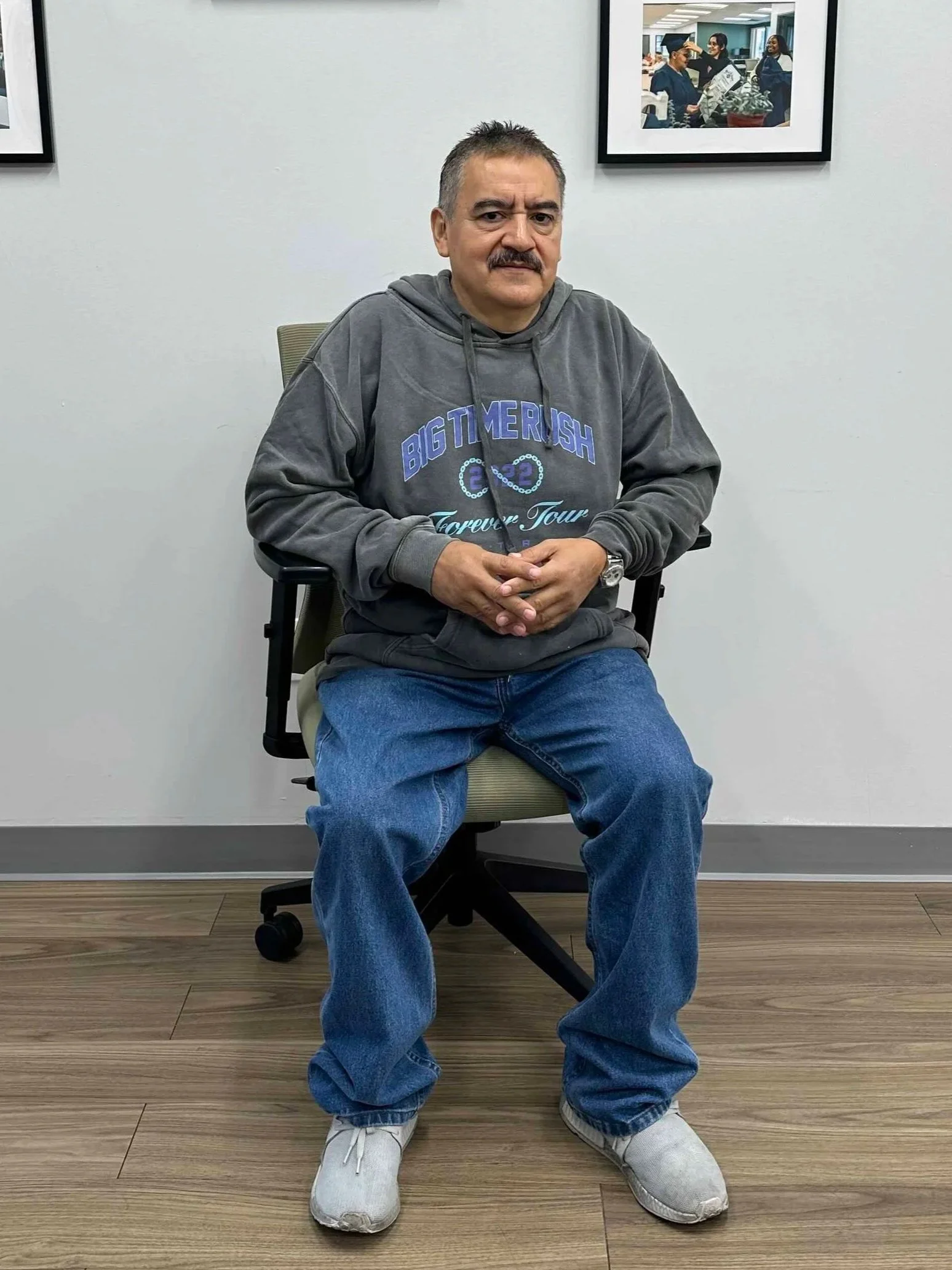
Victor Fuentes
Victor is a 60-year-old Mexican American man who grew up in Hidalgo, Mexico, and now resides in Koreatown. In this interview, he reflects on moments from his childhood with his father and how they both battled alcoholism. He stresses the importance of staying sober, especially at a young age, when many don’t yet understand the consequences of substance use. Between his role in MUEC (Uniting Hands with Hope for the Community) and the quiet moments spent with his guitar, Victor remains dedicated to showing the next generation that a life of sobriety is worth it.
Where Have You Been?
Interview by Pablo Chinchilla, Jennifer Cifuentes, Joyta Biswas
Where is your hometown? Where did you grow up?
I grew up in a little town in Hidalgo called Atotonilco el Grande. I was born in Pachuca, Hidalgo, Mexico, but I grew up in Atotonilco el Grande.
Do you have any hobbies? If so, what are they?
I really like playing guitar. I also enjoy reading. That’s what I do when I feel frustrated or something. Playing guitar calms me down.
Let’s talk about your family. Do you have a partner or children?
Yes, I have a wife, and I had another partner before. I got together with that person when I was very young. We had a child, but we were very inexperienced, so it didn’t work out. I have a 36-year-old son from that relationship, and with my current partner, I have another son who’s now 33.
Do you have any pets?
Yes. We have a cockatoo named Rosco, two little dogs named Pepper and Bella, and a cat named Michi.
Who was your role model growing up?
You could say my uncle was my idol. I admired him a lot. He was like my hero, but he also struggled with alcoholism. I wouldn’t really notice it. I just liked how he paid a little more attention to me. His name was Fernando.
What were your dreams or aspirations as a child?
As a child, I always dreamed of becoming a doctor. Yes, I studied. In elementary school, I was one of those kids who would just hang around, bothering others. I got held back for two years because of that. It hurt a lot when I failed fifth grade because all my friends moved on to another school, and I stayed behind. But then something clicked — like I suddenly understood what they were teaching. From then on, I promised myself I would never fail again, and I never did.
My mind was set on becoming a doctor. I even finished middle school and high school and went into a preparatory course for medicine. But I ran into a big problem: fear, the thing that’s always stolen everything from me. It was fear that kept me from taking that step. Also, [my family was] struggling at home because they didn’t have enough money to help me follow that kind of career.
I talked with different doctors who were my teachers. They loaned me books and everything, but fear always got to me, and I figured I’d end up dropping out halfway. I also wanted to be a priest at some point. I was in the seminary for a long time. I was also an altar boy at my church for many years, and I leaned toward the priesthood, but then a woman came into the picture, and my plans for the priesthood fell through. I couldn’t return to the seminary.
What was your favorite childhood memory?
I had a beautiful childhood because I lived in a small town. Thank God, there was no technology back then — our games were different. We played yo-yos, spinning tops, cup-and-ball, marbles, kick the can, and dodgeball. That’s how we interacted with friends. We’d play soccer at night in the streets and follow the ball with a flashlight. It was so beautiful, you know? But when I entered elementary school, I started to get picked on for my physical condition because school kids can be cruel. That’s when I became an aggressive child. Being aggressive helped me defend myself from others.
What do you do to let go of stress after a tough week?
When I’m a little stressed, I like to be alone and play guitar. I find solace in music. I enjoy listening to classical music, especially the violin. I feel like it speaks to my heart. I can’t even explain how those high violin notes calm me down.
As you know, this project involves interviewing people who have experienced substance use and have gone through a recovery process, as well as their family members and professionals in the field of recovery, to learn from their experiences. We thank you for your bravery in addressing such a complex topic.
We’d like to start the next round of questions. You told us a little bit about your relationship with your father when you were young. How did it feel to see your father struggle with alcohol?
I come from a dysfunctional family. My father had problems with alcohol. I’m the oldest in my family. My parents’ first child died as a baby, and then I was born. I have a sister and a brother.
From what I remember, I’d say when I was 3 or 4 years old, I started noticing my dad’s behavior — he’d come home drunk. It scared me a lot, and I felt this terrible uncertainty because when someone at home is addicted to alcohol or drugs, it can get really bad. You feel isolated. You feel this pain inside that’s hard to describe.
I didn’t understand what was happening to my father or why he was an alcoholic. My mom was passive; she’d cry and try to get us through, but I didn’t understand or know that alcoholism was a disease back then. Since then, I have always said that being the child of an alcoholic or an addict leaves a mark.
Aside from the stigma of alcoholism and drug addiction, I think the whole family is affected. It’s not just one person. In my father’s case, it wasn’t just him — it affected us, too, because he isolated us. We were afraid to throw any parties because his alcoholism would ruin them. We couldn’t go anywhere because if he was drunk, we weren’t invited.
How were you introduced to alcohol?
That was something I always manifested because when I started secondary school, my friends would be like, ‘Come on, just have one. We finished school. We’re grown-ups now! Nothing’s going to happen.’ I was very timid. I always looked like I was cold [anxious]. I’d just stand in the corner. Sometimes, what your friends say really gets to you because deep down, you’re afraid, scared in a way. They say if I drink this, I’ll feel amazing. You’re already emotionally and mentally messed up. It’s not nice to see a loved one get ruined because of alcohol. You shut it out because you don’t like it.
There was a lot of tension in my house between my father and me, mainly because I was the oldest. Once I was older, I wouldn’t let him verbally abuse my mom. He never hit her — she didn’t let him — but he was verbally abusive, and it hurt me hearing the way he talked to her. I wanted to defend her, but I couldn’t because I was just a kid.
On top of that, at school, my friends would bully me — they call it bullying in America — for my physical condition and because my dad was an alcoholic. It was a lot. My father and I became rivals. I remember one time my mom had cooked for us, and he came home and left us with nothing. I asked him what was going on and told him that we hadn’t eaten, and he came at me. He was about to hit me with a big glass bottle. Maybe it’s thanks to my sister, who moved his hand away, that I’m still here telling this story. He was about to hit me very hard; he might’ve killed me.
It was awful, and I didn’t understand it. I went through hell because of him. One time, he came at me and choked me out. I’ll never forget that face — seeing the person who gave you life completely overtaken by rage. I couldn’t understand it. I couldn’t breathe. My mom jumped on him and hit him until he let me go. If you think about it, you’d say, “I’ll never drink because I know what can happen.”
Anyway, let’s get back to the story. After finishing high school, your friends influence you, and you do everything to feel important. Sometimes that’s all there is. You want to feel like you belong somewhere, and alcohol and drugs give you that, at least momentarily. What they don’t tell you is that alcohol and drugs will rob you of everything. [Those substances] show you this platter of nice things that they’ll eventually take away and turn into anxiety, suffering, and so much more.
I drank. When I first drank, I felt what alcohol does to you. You lose your inhibitions, you feel attractive, and you feel important. You can say or do things you normally can’t. I thought, Wow, where have you been? I needed you so much. I passed out the first time I drank. That’s when I started drinking heavily.
When I’d wake up, the guilt would crush me. How could this be? My mother and I had lived through the consequences of alcoholism, and now I was going down the same path. I’d wake up confused, not knowing what I’d done, beaten, bloody, and terrified of what I might have done or what others might have done to me.
Maybe because of all the emotional damage I was carrying, alcohol felt like a crutch, like some kind of support to help me keep going. But it’s sad because alcohol and drugs take everything from you. They leave you no choice. It’s a lie when people say, “I drink, and I’ll be able to stop.” There’s a point, an invisible line you cross without realizing it. And once you cross it, there’s no going back.
It’s very hard to say no because your body — the addiction — is so strong that you’d even give your life just to feel that feeling alcohol or drugs gives you. It’s hard. Plus, as a young person, sometimes you don’t realize you’re entering a thorny path that’s going to hurt you badly, and you’ll drag your whole family along with you through alcohol and drug use.
When was your first experience with alcohol? Were you in a park, at school, or at a party?
I was about 15 years old when I started drinking. Look, I was also working. I was a librarian, and when you drink, you lose your inhibitions; you lose everything. The library I worked in turned into a bar at night, and all my friends would come. You stop caring. When you drink, you don’t care.
The first thing I lost to alcohol was my shame. I passed out on the street outside a school. I heard some noise and realized lots of students were walking by. What can you do? I pretended to be asleep so I wouldn’t have to deal with that.
When you started drinking, did your siblings or your mother know?
My siblings were younger than I was. My mom knew. I think, besides everything, that was one of the things that hit me the hardest: seeing my mother cry. I would’ve preferred that she hit me or yelled at me, but it hurt to see her cry. Seeing her cry was too much.
What signs or changes did you notice that made you realize alcohol was affecting your life?
How I’d hurt my mother. I remember once I drank so much that I got lost. I was the town librarian, but I also worked at the town hall. The town hall was full of drunks, even the mayor himself. To protect his image, whenever his workers were drunk, he’d send them to jail with the other prisoners.
I went to jail one time, but one of my friends realized I was in bad shape. I was dying of alcohol poisoning. They called a doctor, but the doctor couldn’t bring me back. They have ambulances here [in America], but not [in Mexico then]. One of my friends, the strongest one, carried me a long distance to the health center, and there they managed to bring me back.
I woke up on a prisoner’s cot with IVs in both arms. Aside from the physical pain from the alcohol and an intense moral hangover, I spent the whole day in jail. When I was able to get up, I went home, but my mom could see from my face that I was in bad shape. ‘Where have you been? Look at you!’ When you’re an addict — an alcoholic or a drug addict — your ego and pride always kick in. “What are you talking about? I’m fine.” When I told her I was fine, my shirt slipped, and she saw the IV marks. My mom started crying. Again. That was one of the things that hurt the most in my life: making my mom suffer.
Think about it — [my mom] is the person I love most in the world, and I caused her so much pain. When you’re young, your parents or loved ones tell you, ‘Be careful because drugs and alcohol can get you into serious trouble,’ but you don’t understand. You’re a rebel. On top of the emotional damage you’re carrying, you think you own the world and that you’ll conquer it all. But it’s a lie because alcohol and drugs bring suffering, and if you’re not prepared, they will get the better of you. Maybe it will be very challenging when you want to stop drinking or using drugs. Addictions are strong. Without help, it can be too much.
When did you first realize you had a problem with alcohol?
You know, my dad couldn’t function anymore because of his alcoholism. He’d have seizures and pass out on the street; he’d have convulsions. He was on the verge of losing his life. The irony is that I was also drinking by then, but I was trying to find a cure for my dad. That’s how unaware you are under the influence of alcohol and drugs; you don’t realize that you’re in the same situation as others.
I took my dad to a rehab center because I didn’t want him to die, but I never imagined that I would hear so many stories there. They started to talk, and that’s when I realized I had a problem. For the first time in my life, I accepted that I needed to do something because I was drinking so much.
Little by little, you increase your dose. Those addicted to drugs and alcohol believe that they’ll get to feel the same way they did the first time, but they can’t. It’s a lie. You’ll need larger and larger doses just to feel anything like what you felt the first time. That’s when I realized and admitted that I had a problem called alcoholism.
If you could share a message with your father, what would you say?
Look, I loved him very much, but something broke between us because of his alcoholism. The resentment and anger I had made me distance myself, but I’d tell him that I love him very much. I missed him a lot and still do. Alcoholism took him away from me. It took my father and my uncle. Alcoholism kills.
Picking up where we left off, I’m going to ask you questions about your thoughts on substance use and recovery. You mentioned earlier that you were willing to help your father enter a recovery program. Why didn’t you want to seek treatment for your own recovery at the time?
As I said, you don’t realize you have an addiction. When you start drinking or using drugs, you think you’ve got everything under control and that it’s never going to get out of hand.
I have a funny story. I was a musician in my town. Once, a speaker wasn’t working, so I opened it and found some baby mice inside. I heard that if you put them in a bottle of alcohol and an alcoholic drinks it, it’ll make their whole body itch. That’s not true, but I’d heard it. I found the nest of mice and thought, My dad — why didn’t I think of myself? I was already in a bad state, but pride and arrogance make you believe you don’t have a problem.
That’s why it’s so hard for someone with an addiction to accept help. You think everything’s under control and that the people around you are wrong. You think you’re fine, that you’ve got it all handled, and there’s no way you’re going to mess it up.
What kind of recovery program did your father participate in?
He was part of Alcoholics Anonymous, the 12-step program, but it was in an inpatient program. There comes a point when it’s hard for the addict. Deep down, they know they need help, but they reject it at the same time because it’s so difficult to admit that they have a problem. It doesn’t matter if it’s drugs, alcohol, or any other addiction. “An alcoholic? A drunk? No, that’s not me! I only drink every once in a while.” You even lie. If someone asks if you drink, you say, “Only once in a while.” Once in a while? It’s all the time!
Denial is a huge part of this illness. You’re never going to admit that you have a problem. If you don’t acknowledge that you have a problem, whether it’s with cigarettes, alcohol, or drugs, it’s going to be very difficult to recover. In that recovery group, I realized that I had problems with alcohol.
How did this program help your father’s recovery?
My father was an inpatient for a year. What I didn’t expect was that every month I had to bring him groceries, so I had to sit in a chair and listen to others’ experiences, which tore me to pieces. I’d think, My dad must’ve lied and told them all the things I’ve done to him or what I do now. Because I saw myself in their experiences, I felt shame and anger. I’d keep my head down because I was sure my father had told them everything I’d done. But no, that wasn’t true. It was just a reflection of myself. I was seeing myself in those who spoke. That’s what helped me.
What motivated you to begin your recovery process?
What motivated me to seek help, like I was saying, was that I played in a band. The older brother of one of the guys had already been to [the United States]. He brought the Alcoholics Anonymous program to my town. You should’ve seen the uproar! They wanted to burn that guy alive! When an alcoholic or addict gets confronted like that, it’s like showing a cross to the devil — they can’t accept it.
In AA, there’s a preamble that tells you what Alcoholics Anonymous is. I knew it by heart. It was painful because when we were sitting there drinking, this guy would play the record that said, “Alcoholics Anonymous is a fellowship of men and women.” I already knew it, but it still made me angry. I’d think, What are you talking about?
That guy insisted so much that I finally went to the 12-step group. Even to this day, I remember the stories of those people because they spoke a language I understood. I said, “Their words really resonate with me. I need this.” But I didn’t stay. I came to this country, and I stopped drinking in 1989. I got to this country and spent ten years without a group or anything, but I started having emotional problems again, and that urge to drink came back. My wife joined Neurotics Anonymous before I did, and that’s how I ended up in Alcoholics Anonymous.
That 12-step group has helped me a lot, and I was able to understand what alcoholism really is. I know it’s a disease and not a vice; the same goes for drugs. They’re insidious and have fatal consequences because they can kill you. In the group, they tell you things very bluntly, but it’s the truth. Some people say that alcohol isn’t bad — it is fun for some. There are people who can have one drink and spend the whole night with it, but not us alcoholics. We go to a party and have two or three beforehand just to get a buzz because we know drinks are expensive. We stock up before. Alcoholics and addicts are very crafty, and it’s incredibly hard to admit that we have a problem.
What helped you the most back then?
Understanding that [using] alcohol and drugs is just the last symptom of much deeper issues [helped me]. I was already damaged inside, psychologically and emotionally. I lacked a lot of affection from my parents, and I found fake love in alcohol that seemed to meet that need. I realized that alcohol was just, as I said, a crutch to help me with all the emotional problems I carried.
I was scarred. For example, in my case, I was abused in so many ways: physically, mentally, and sexually. You keep all that to yourself, but it’s like a ticking time bomb that’s going to explode as you grow up. It comes out in fits of rage. I had a terrible temper because I kept remembering what I went through as a kid. For me, that was really hard. I had to face myself and get to a place where others told me, ‘Don’t worry. You’re not the only one. If I made it, so can you.’
How did your perspective change after recovery?
Oh, it’s a whole different world. Living life without alcohol or drugs is wonderful. When you’re a drinker, you ask, “Is there a party?” ‘Yes.’ “Will they have alcohol there?” ‘No.’ “No? I’m not going then.”
With my friends, we’d go to churches but not to pray. We’d check church announcements that said, “So-and-so is getting married on this date.” I’d take notes. Then we’d show up in town and say, “What did you find?” ‘I’ve got a quinceañera and two weddings.’ “What do you think?” ‘Nah, I don’t think there’ll be booze here. Maybe this one because they’re big drinkers. Let’s go to that wedding.’ Look at that, you’re not even invited, but you invited yourself. That’s alcohol. People who don’t know it think it’s wonderful, like a different world. Same with drugs. It’s tough.
Now, if I’d had access to programs like this back then, I assure you I wouldn’t have gone through what I went through. Ending up passed out in a park, not knowing where you are — I have scars on my hands from cuts, from falling, and from shameful things, things you’ve done in life that make you say, “That’s why I’m in this 12-step program.”
A lot of young people are joining now, but the problem is even bigger because now they have synthetic drugs that are way too strong, drugs we didn’t even know about back then. Honestly, I congratulate you all [KARS participants] because it takes courage to come to these meetings — not everyone can. That’s why these kinds of groups are often empty. These groups aren’t for whoever wants them; everyone needs them, but nobody wants them.
Now, the support groups are being abandoned because drugs and alcohol are winning the battle. People who use or sell drugs use social media and whatnot to attract young people, who are the most [crucial demographic]. My respect goes out to programs [like KARS] because they are very rewarding and can spare a young person many years of suffering.
Thank you for sharing your story. We’re getting to the end of the interview. What experiences have been the most meaningful in your life?
There’s been a bit of everything. What I’m truly grateful for is that I was able to quit drinking thanks to programs run by people who genuinely care. Honestly, in this country, many agencies are concerned about young people. I think that’s so nice. I feel grateful that programs like [KARS] exist. Whenever I can spread the word, I do.
What has been the happiest moment of your life?
There have been many. One of the happiest things in my life was my childhood. Despite everything I went through, my childhood was very beautiful. There’s one memory I hold dear. I once went fishing with my father. It was one of only two times that I went out with him. I remember the lagoon where we went fishing. It was very cold, and he wrapped me in a blanket. It was so spontaneous, and I had never experienced anything like it, so I’ve always kept that memory close to my heart.
Who has been the kindest person to you?
When I was drinking, there was a guy I couldn’t stand. I was scared of running into him because he’d always ask me, ‘Why are you drinking? What’s your problem? Do you want to die?’ He was really hard on me, and I hated him for that. I didn’t dare to say it to his face, but inside, I tore him to shreds.
When you’re drinking or using, having someone preach to you is horrible. It makes you furious. But now I understand that he was the only person, besides my parents, who was trying to show me I was going down the wrong path. He has passed away now, and I remember him dearly because he was one of the few people who showed me kindness. He truly cared about me.
At what point in your life have you felt most alone?
I felt alone all my childhood and much of my teenage years. Loneliness is awful. There’s a saying that goes, “An idle brain is the devil’s workshop.” When you’re alone, when you feel like no one cares about you, you don’t worry about who’s going to invite you out. You worry about what you’re going to invite yourself to or the little shot you’re going to pour for yourself.
I’ve often felt alone, and loneliness grabs you, squeezes you, and tears you apart. You can be surrounded by lots of people but still feel alone. It’s an inner emptiness that neither drugs, alcohol, nor women can fill. Nothing. Nothing will fill it because it’s a void that crushes you and breaks you apart.
How would you like to be remembered?
[I’d like people to remember me] as someone who managed to move forward, quit alcohol and drugs, and cares about making sure other people don’t go through what I went through. It’s painful and intense. It’s sad how alcohol and drugs can steal everything from your life.
Do you have any regrets? What are they, and what would you do differently?
In the 12-step program, I’ve been able to forgive myself. You see, if you don’t forgive yourself, you’ll hurt yourself for the rest of your life. I’ve worked hard to forgive myself. I can’t do anything about what I’ve already done, but I can certainly try to keep moving forward clean today. Up until today, by the grace of God, I haven’t drunk or used drugs.
I always try to be there for my community when they need me and tell them that there’s a different life without alcohol and drugs. Everything alcohol and drugs have stolen from you — if you have the inner strength to say no, it’ll bring you a lot of benefits and save you from 15 or many more years of suffering. I congratulate you all [KARS participants] and hope you never experiment with alcohol or drugs because they kill. It sounds harsh, but it’s true.
Lastly, why did you decide to share your story?
So you can see that living under the influence of drugs and alcohol, what they tell you is a lie. What drugs make you feel momentarily is a lie. When you start using drugs or alcohol, you feel different. You feel important. Yet little by little, you start to go downhill. There comes a point when that joy, that feeling you had, turns into suffering. It drags you down to the lowest point, and your whole family goes down with you. You have to respect alcohol and drugs because they slowly destroy you. That then causes suffering, and I don’t recommend it.
Before we finish, I have a few questions. What programs are you a part of at KYCC?
I’m in MUEC (Uniting Hands with Hope for the Community), but I’m mainly interested in addictions. I’d like to learn more about addictions because [the KARS students] have the knowledge, but I’ve got the firsthand experience of having lived through it. So it complements and expands my knowledge to help my [community] or the people I meet out there.
In those programs, what role do you play in this organization?
First, I was a member of MUEC. Now, I’m a leader. It’s a very nice role because it helps you grow in a certain way. I love that these programs exist because we can reach many people, even if we only scratch the surface of addiction and alcoholism. But we’re doing something, and I feel useful.
Thank you very much for sharing your story with our youth group and also for sharing everything you’ve been through. You’ve already talked a little bit about why you’re part of KYCC and the groups here. Do you mind sharing an inspiring message for those who will read this? As a society and community, what do you think we could do to reduce the stigma, not just around alcohol use but also recovery, so that we can be more compassionate with those going through hard times?
I think we need to make the programs more appealing. Get young people more involved because sometimes they think it’s boring. It’s great that you are young and can connect with them, but, for example, when young people see an older man like me, they think, Oh, what can that old guy teach me? We need to be more appealing to catch their attention. Just like the people selling drugs catch them, we need to do that as well, but to save them from what we’ve gone through.
What can we do as an agency or as a community to raise more awareness of these programs, particularly recovery programs?
You’re already doing a good job, but I think we need to get more involved in schools. For example, my grandson is in the eighth grade. They have problems with marijuana there. [The students] smoke in the bathrooms. Two weeks ago, someone got intoxicated because they brought marijuana gummies.
We can’t sugarcoat things with kids anymore. I don’t know if it’s society’s fault because it sets a lot of rules and stuff, but drug dealers don’t. They often get ahead of us. Take music, for example. Music glorifies drug dealers and this fake lifestyle that doesn’t exist. It’s all a lie. But young people think Peso Pluma or guys like that are the best thing ever and someone to look up to. Those are the things we’re up against. We have to be smarter.
How do we capture young people and get Peso Pluma out of their heads? It’s very hard sometimes. As I said, you can already see it in our recovery groups. The groups start to empty out, but we already know that during the holidays, in December or January, a lot of young people drink. They show up with a DUI, and the groups fill up again.
Yes, I think we need to work more with the community, visit schools, and tell young people, “Look, life can be different without alcohol and drugs. We left that hell, and we don’t recommend you go there because you might not make it out. I made it, but don’t even try it. There’s a better life without alcohol and drugs.” It’s wonderful to sit and have a coffee, talk with your friends, or enjoy yourself in a healthy way. Why get into alcohol and drugs?
The problem is that in your circle, there’s always someone. There’s always someone who’ll try to pull you in because they’re already in it, and they don’t want to go down alone. They want to drag everyone with them.
Let me tell you about one of my boys. We brought him to the group. We worked with him, but he didn’t want our help. He’s in prison now. It’s sad because he’s regretful now, but it’s too late. He never believed alcohol and drugs would land him there, but now he’s there. I don’t think it’s fair. I look at these young people — they have their whole lives ahead of them. Why? Why waste it on things that will only hurt you? Maybe you’ll even drag your family into a world they’re not prepared for.